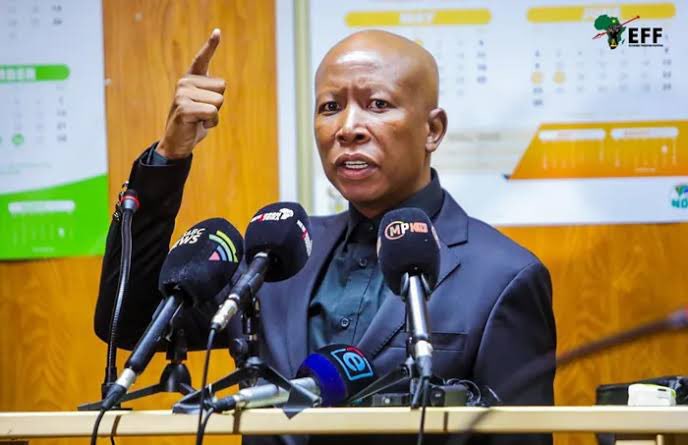

Julius Malema appeared in court in KuGompo City for pre-sentencing proceedings after being found guilty in 2025 for unlawfully discharging a firearm during a 2018 rally. Image: Supplied.
EFF
EFF leader Julius Malema faces harsh jail sentence push
Julius Malema appeared in court in KuGompo City for pre-sentencing proceedings after being found guilty in 2025 for unlawfully discharging a firearm during a 2018 rally, with the State pushing for a 15-year prison sentence. The defence opposed a custodial term, arguing for a non-custodial sentence.

Julius Malema appeared before the Magistrate’s Court in KuGompo City on Wednesday for pre-sentencing proceedings in a firearm case in which he was found guilty in 2025 for contravening South Africa’s gun laws.
The matter stems from a 2018 political rally where Malema was captured in a viral video discharging a rifle in front of a large crowd estimated at about 20,000 supporters. The incident sparked public outrage at the time and later formed the basis of criminal charges relating to unlawful possession and discharge of a firearm in a public space.
On Wednesday, the court heard final arguments in aggravation and mitigation of sentence, with both the State and defence presenting sharply opposing views on appropriate punishment ahead of sentencing scheduled for Thursday.
State prosecutor Advocate Joel Cesar told the court that Malema’s conduct was reckless and placed thousands of people at risk. He argued that the offence went beyond a moment of poor judgment and reflected behaviour that undermines public safety and the rule of law.
Cesar urged the court to impose a 15-year direct imprisonment sentence, arguing that a harsh penalty was necessary to deter similar conduct in future political gatherings. He said the court must send a clear message that firearm laws apply equally to all individuals regardless of political status.
The National Prosecuting Authority, through its Eastern Cape spokesperson Luxolo Tyali, confirmed outside court that the State is seeking a 15-year custodial sentence. Tyali said the request reflects the seriousness of the offence and the need to discourage the unlawful use of firearms in public.
Malema’s legal team, led by Advocate Tembeka Ngcukaitobi SC, opposed the State’s application for direct imprisonment. Ngcukaitobi argued that the prosecution was mischaracterising the conviction and attempting to extend punishment beyond what the court had found proven.
He told the court that Malema should not be sentenced as though he had committed a more serious offence than the one for which he was convicted. He submitted that a non-custodial sentence would be appropriate and proportionate, and warned that a lengthy prison term would be unjust in the circumstances.
Ngcukaitobi further argued that the State’s proposed sentence did not align with the evidence and suggested that it would have wider political consequences, including the potential to heighten tensions in the country.
Inside the courtroom, Malema sat listening as arguments were presented, while supporters filled the public gallery. Outside the court, large groups of Economic Freedom Fighters supporters gathered, dressed in red berets and party regalia. They sang struggle songs, chanted slogans, and waved flags throughout the proceedings.
Malema was accompanied in court by family members, including his wife Mantoa Malema and his eldest son, who were seated behind the defence team during proceedings. Their presence formed part of visible family support as the case reached its final stage before sentencing.
Security around the court precinct was significantly heightened. Members of the South African Police Service were deployed in large numbers to manage crowds and maintain order amid concerns about possible unrest depending on the outcome of the case.
Authorities said the deployment was a precautionary measure, given the high public interest in the matter and the political profile of the accused.
Earlier in the day, EFF Member of Parliament Sinawo Thambo said the party remained stable and would continue functioning regardless of the outcome of the case. He emphasised that the organisation was not dependent on any single individual and would continue its political programme.
Following the court session, Malema addressed supporters outside the courthouse. He maintained that the case against him was politically motivated and accused critics of attempting to silence his political voice.
“We are here because of AfriForum, which wants to silence the voice of black people,” Malema said, referring to the civil rights organisation AfriForum.
He further stated that economic interests were being used to suppress radical political expression, saying, “There is no doubt that capital has a central role in attempts to silence radical voices in South Africa.”
Malema told supporters that he remained defiant and would not be silenced regardless of the court outcome. He also thanked supporters who gathered outside court and urged them to remain peaceful.
“They can imprison me, but they will never imprison my ideas,” he said.
Critics, however, argue that the case is not about political ideology but about accountability for unlawful conduct involving firearms in a public setting.
Political analyst Dr Ongama Mtimka said the case highlights the distinction between political expression and criminal responsibility. He noted that while Malema’s rhetoric reflects that of a liberation-style political leader, the court is dealing strictly with a criminal conviction.
Mtimka said the key issue before the court is not Malema’s political views but his actions, adding that the law applies equally to all citizens.
The case has also reignited broader debate about the use of firearms at public and political gatherings, with observers noting that celebratory gunfire has been seen at various events across different political formations, raising questions about consistency in enforcement.
Attention has also been drawn to the absence of Malema’s bodyguard, who allegedly handed him the firearm during the 2018 incident but was not present in court proceedings.
As Wednesday’s proceedings concluded, the matter was postponed to Thursday for sentencing, which is expected to attract significant public attention and a heavy security presence.
The outcome is likely to have major political and legal implications, as the court determines whether one of South Africa’s most prominent political figures will face imprisonment or an alternative sentence.