


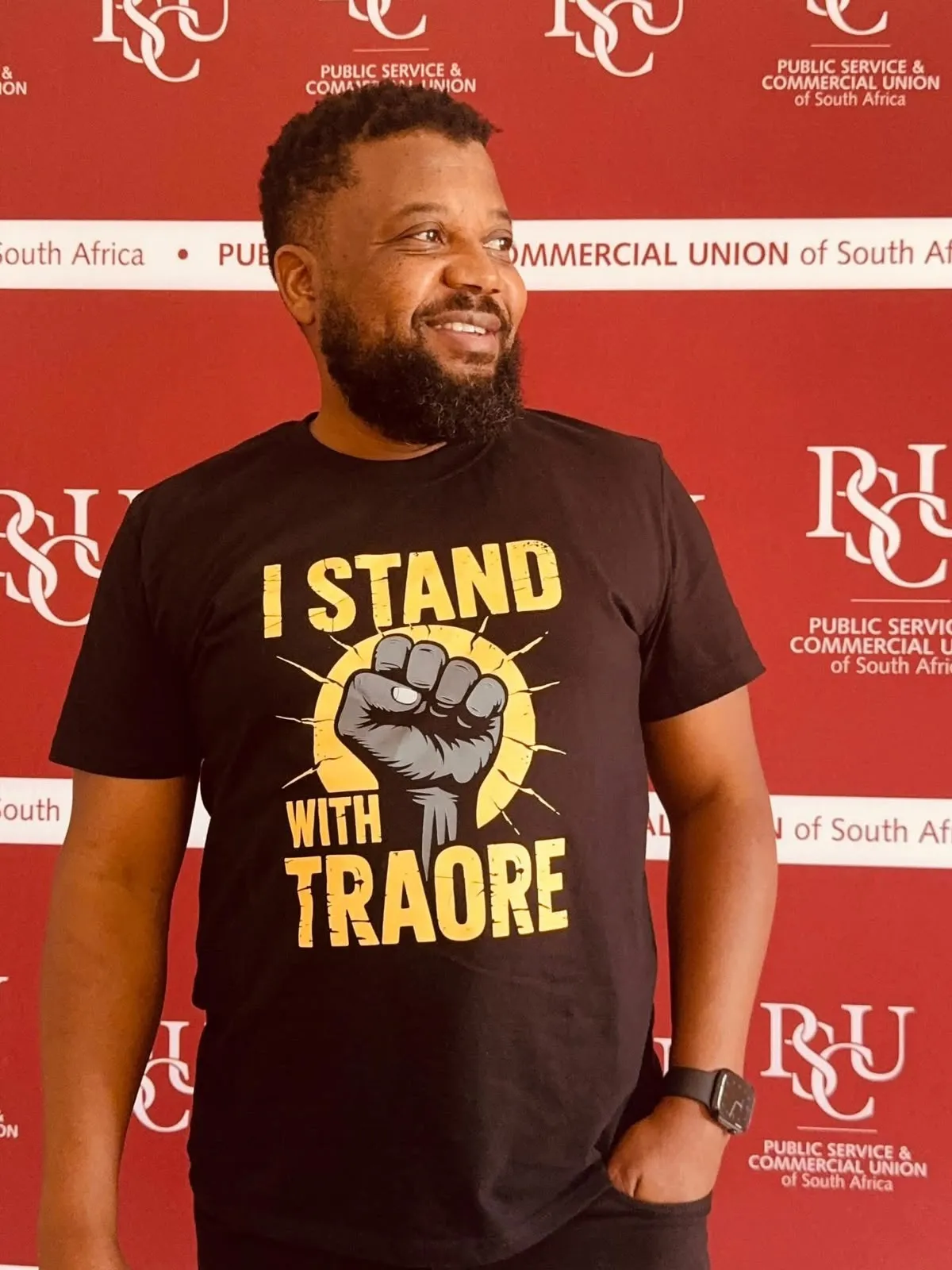

Secretary General, Public Service & Commercial Union of South Africa (PSCU). Image: Supplied.
GEPF
1Min
South Africa
PIC crisis goes beyond Dlamini saga, calls for workers’ fund governance review
The recent court ruling concerning the suspension of the PIC’s chief executive has exposed deeper governance concerns that extend beyond one individual or one dispute. The real question is whether South Africa’s governance framework for institutions entrusted with workers’ retirement savings remains fit for purpose.
The Public Investment Corporation (PIC) is widely regarded as one of South Africa’s most important financial institutions. However, this is an understatement of its deeper significance to the country’s economy and, more importantly, to the millions of public servants whose retirement interests are tied to the Government Employees Pension Fund (GEPF).
The recent court ruling declaring the suspension of PIC chief executive Patrick Dlamini unlawful has brought the governance crisis at the PIC into sharp focus. This follows weeks of instability at the institution, including disagreements between the board and the Minister of Finance, the departure of the former chairperson and the resignation of several non-executive directors.
The Financial Sector Conduct Authority has also initiated an investigation into developments at the PIC citing concerns regarding governance, leadership stability, transparency and conduct. Therefore, it would be an understatement to describe the situation at the PIC as a mere boardroom dispute.
The problem is far more significant.
The PIC manages trillions of rands, most of which belongs to the GEPF. These are not simply government funds in the conventional sense but are overwhelmingly assets accumulated through the contributions of public servants over their working lives.
From the classroom to the hospital, from the police station to the correctional facility, publicmservants contribute to the pension system throughout their careers. Their pension contributions are deferred earnings. This means that the governance of the PIC and GEPF is not merely a matter for the Minister of Finance, the board, organised labour or investment professionals but is a matter for workers.
The Dlamini judgement is a symptom, not the disease.
The court’s decision that Mr Dlamini’s suspension was unlawful is significant, but it would be a mistake to conclude that resolving the dispute surrounding the CEO will resolve the PIC’s governance problems.
It will not.
The question that South Africa should now be asking is why an institution of such systemic importance reached a point where the board suspended its chief executive, the decision was successfully challenged in court, the chairperson subsequently resigned, several directors resigned and the financial-sector regulator considered it necessary to launch an investigation.
These developments point to weaknesses in the governance architecture, they suggest that the lines between the shareholder, the board and executive management are not sufficiently clear. Where responsibility is unclear, accountability becomes equally unclear. This is dangerous in any institution and particularly so in an institution managing workers’ retirement savings.
Who is ultimately accountable for the PIC?
South Africa has developed sophisticated systems of accountability for public institutions.
These include shareholders, boards, executive management, regulators, Parliament, the
National Treasury and various committees.
While this may appear comprehensive, multiple layers of accountability do not necessarily
ensure effective governance. The experience of South Africa’s state-owned enterprises has
demonstrated this repeatedly. An institution can have boards, ministers, regulators, auditors,
parliamentary committees and legislation yet still experience significant governance failures.
The problem is often not the absence of accountability structures but the quality,
independence and competence of those entrusted with exercising them. This is where the PIC
debate should now focus. Competence must become a legal requirement.
The first principle should be straightforward: no one should be appointed to a PIC or GEPF
board unless they are demonstrably competent to perform the responsibilities attached to the
position. This may seem obvious but the current debate suggests that South Africa has not
sufficiently institutionalised this principle.
The PIC is an investment institution operating in some of the most sophisticated financial
markets in the world. Its directors are expected to oversee investment portfolios involving listed
equities, unlisted investments, infrastructure, property, private markets, debt instruments and
other complex asset classes. This requires specialised knowledge.
A person may be an excellent trade unionist, politician, lawyer, academic or public servant but
still not necessarily possess the investment expertise required to serve effectively on such a
board. This is not an insult but a recognition that different responsibilities require different
skills. A pilot cannot fly an aircraft simply because he has been nominated by the passengers.
A surgeon cannot perform an operation solely because the hospital board trusts them.
Why should the governance of trillions of rands be different?
Representation is important but is not equivalent to competence.
PSCU supports the principle of worker representation in pension governance. Trade unions
have a legitimate interest in ensuring that workers’ interests are protected, however, there is
a risk when representation becomes an end in itself. A trade union nomination should not
automatically translate into a board appointment. The same principle should apply to
government nominees and every other stakeholder. A person nominated by a union must
satisfy the same competency requirements as a person nominated by government.
The question should not be: Who does this person represent?
The first question should be: What qualifies this person to oversee workers’ retirement
savings?
Only after that question has been satisfactorily answered should representation become
relevant. This is not about excluding organised labour but ensuring that labour representation
is meaningful.
South Africa also needs to confront the question of tenure.
Another issue that requires attention is the length of time some individuals remain on pension
and investment boards. Experience is valuable and institutional memory is valuable, however,
there comes a point where continuity can become stagnation.
Long-serving board members can become deeply familiar with the institutions they oversee.
That familiarity can be beneficial but can also create risks around independence, renewal and
accountability. A modern governance system should therefore provide reasonable limits on
tenure. There should be fixed terms, staggered rotation and objective criteria for
reappointment. No individual should regard a board position as a permanent entitlement.
The institution must always be greater than the individual.
The political question cannot be avoided.
The PIC’s relationship with the State also needs to be reconsidered. The State is the
shareholder while the Pension Investment Corporation (PIC) manages assets predominantly
belonging to the Government Employees’ Pension Fund (GEPF). This creates a unique
governance arrangement.
The shareholder has legitimate responsibilities, but these should not translate into political
control over investment decisions. The PIC is an asset manager whose investment decisions
should be based on principles of investment, risk assessment, fiduciary responsibilities and
long-term value creation. They should not be driven by political expediency.
The recent developments should therefore prompt a review of whether political office-bearers
should occupy positions of governance at an institution whose principal function is professional
investment management. There is an important distinction between political oversight and
political management. South Africa needs the former and should guard against the latter. The
GEPF cannot be excluded from the reform discussion. It would also be a mistake to focus
solely on the PIC. The GEPF is central to this issue. The PIC manages the assets, but the
GEPF represents the retirement interests of public servants. The governance of the two
institutions is therefore inseparable.
If we are serious about protecting workers’ retirement savings, the competency, independence
and tenure of the GEPF Board must receive the same scrutiny as those of the PIC. The current
crisis provides an opportunity to review both institutions rather than treating the PIC as an
isolated problem. The defined-benefit argument is not sufficient. Another argument needs
to be challenged. It is sometimes suggested that because the GEPF is a defined-benefit
pension fund, workers should not be overly concerned about investment performance or the
governance of the assets. This argument overlooks an important point. A defined-benefit
arrangement provides members with a defined pension benefit according to the rules of the
fund.
This does not imply that workers have relinquished their legitimate interest in the management
of the assets supporting those obligations. Public servants contribute throughout their working
lives and have every right to expect their contributions to be managed prudently, transparently
and professionally. The fact that the State ultimately guarantees pension obligations does not
render workers’ contributions unaccountable.
On the contrary, the more significant the State’s obligations the greater the need for sound
governance of the assets supporting them. The current crisis presents South Africa with an
opportunity to rethink the governance of public pension investments. Several principles should
guide this process:
Professionalise the boards: All PIC and GEPF directors should be subject to mandatory
competency and fit-and-proper requirements. These should include appropriate knowledge
and experience in investment management, finance, accounting, actuarial matters, law, risk
management, capital markets and corporate governance.
Separate political oversight from investment management: The State should retain
appropriate shareholder and policy oversight, but investment decisions must remain the
responsibility of professionally governed institutions. The chairperson and directors should be
selected for their competence, independence and integrity rather than their political office or
organisational status.
Strengthen beneficiary representation: Workers must have a meaningful voice in
institutions responsible for their retirement savings. However, worker representatives must
meet the same professional standards required of every other director. Representation and
competence must reinforce each other.
Introduce reasonable term limits: Boards require renewal. There should be maximum
cumulative tenure staggered appointments and independent performance assessments.
No organisation should be permitted to treat pension board positions as permanent
organisational property.
The PIC cannot be fixed by simply changing its leadership.
There will inevitably be pressure to resolve the current crisis by appointing a new board and
moving on. This would be insufficient. Changing individuals without altering the system will
simply create the conditions for another crisis in the future. The PIC requires a governance
reset. The GEPF requires the same scrutiny. Parliament should therefore review the
legislation governing both institutions and consider whether the current framework adequately
protects the interests of pension beneficiaries. The process should involve Government,
organised labour, the financial-sector regulators, investment professionals, governance
experts and, importantly, representatives of pension beneficiaries.
Workers’ money requires workers’ confidence.
The PIC is too important to South Africa to become permanently associated with boardroom
instability. The GEPF is too important to public servants to become an afterthought in the
governance debate. And workers’ retirement savings are too important to be managed through
a system where questions of competence, independence, tenure and accountability remain
unresolved. The court has addressed the immediate question concerning the lawfulness of
the CEO’s suspension. The FSCA will address matters within its regulatory remit. However,
there is a much larger question for Parliament and Government.
Is the governance architecture of the PIC and GEPF fit for purpose?
PSCU believes this question cannot be avoided. We must move away from a system where
board appointments become primarily concerned with representation, political office or
organisational affiliation. We need a system where the first consideration is whether the
individual is capable of safeguarding workers’ retirement savings. This is not about Patrick
Dlamini, David Masondo, Enoch Godongwana or any particular union. It is about an institution
managing the retirement interests of millions of workers.
The PIC must belong to the future not to the politics of the past. Workers’ money
requires competent governance and their pensions require accountability. South Africa
must now have the courage to fix the system before the next crisis forces us to do so.