



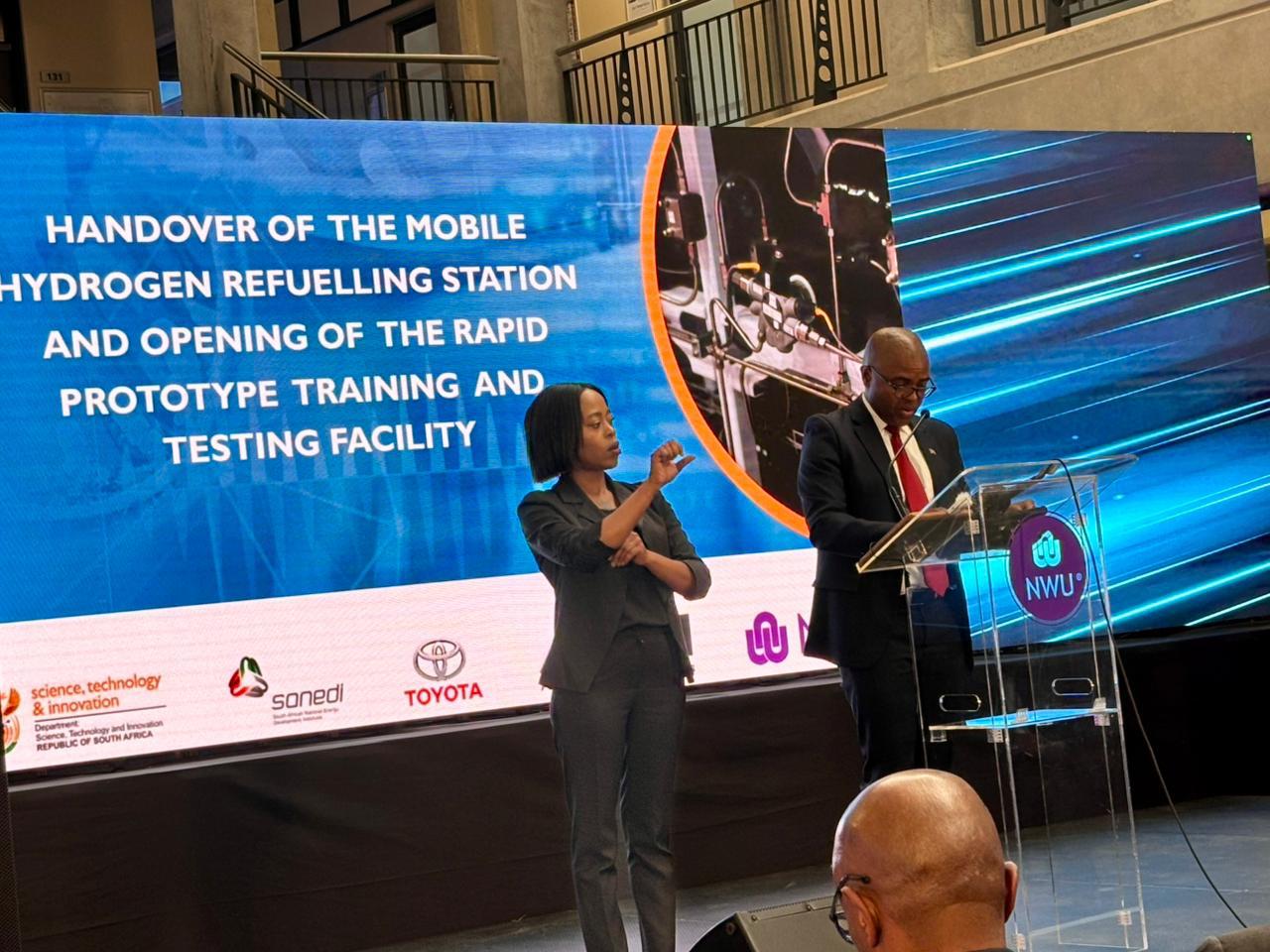

The Department of Science, Technology and Innovation (DSTI) has officially handed over two major energy research and innovation facilities at North-West University. Image: Supplied.
North West
1Min
South Africa
DSTI unveils hydrogen and energy innovation facilities at North-West University
Government and industry partners are driving South Africa’s clean energy ambitions forward with the launch of cutting-edge hydrogen and innovation facilities at NWU’s Potchefstroom campus.

The Department of Science, Technology and Innovation (DSTI) has handed over two strategic energy research, development and innovation (RDI) deployments at the North-West University (NWU) Potchefstroom Campus.
The handover forms part of the Department's contribution to South Africa's just energy transition, the hydrogen economy and the country's long-term net-zero carbon ambitions.
The two deployments that were launched were the Mobile Hydrogen Refuelling Station and the Rapid Prototyping, Testing and Training Facility (RPTTF), developed under the DSTI's energy RDI flagship programmes.
The Director-General of the DSTI, Dr Mlungisi Cele, delivered the keynote address on behalf of the Ministry of Science, Technology and Innovation.
Dr Cele said the handover demonstrates the successful translation of publicly funded research into tangible infrastructure that supports industrial development, skills creation and environmental sustainability.
"These facilities reflect our commitment to positioning science, technology and innovation at the centre of South Africa's industrialisation agenda. They show how strategic partnerships can deliver solutions that contribute to economic growth, energy security and the decarbonisation of the economy," said Cele.
The Mobile Hydrogen Refuelling Station, located at NWU, was completed in February 2025 through a partnership between the Hydrogen South Africa (HySA) Infrastructure Centre of Competence and Toyota South Africa Motors.
Prof. Jeffrey Mphahlele, Deputy Vice-Chancellor for Research and Innovation, Community Engagement and PG Studies at NWU also emphasised the importance of collaboration for a sustainable future.
"Partnerships between academic institutions, government and the private sector are essential for advancing South Africa's energy future through shared expertise, innovation and coordinated action. By aligning research capability with policy direction and industry implementation, these collaborations create practical pathways for developing sustainable solutions in the energy and fuel sector."
"Advancements in hydrogen research and implementation provide an opportunity to accelerate clean energy development, strengthen energy security and unlock new economic opportunities," he said.
The station represents a major step forward in advancing hydrogen mobility in South Africa and directly supports the decarbonisation of the transport sector in line with the DSTI's Hydrogen Society Roadmap. It serves as a demonstration platform for hydrogen fuel cell electric vehicle technologies, as illustrated with the Toyota Mirai at the launch.
The station also showcases locally developed intellectual property and strengthens collaboration between public and private sector partners in building an integrated hydrogen value chain.
The RPTTF was officially opened as part of HySA Infrastructure's strategic research and innovation platform. The project was developed with DSTI as the primary funder in partnership with the NWU, with additional support from African Rainbow Minerals.
The RPTTF is designed to accelerate the incubation, development and demonstration of water electrolysis technologies, which will support innovation in green hydrogen production, component development, system integration and the scaling of technologies from laboratory to pilot and industrial levels.
Fully operational since early 2025, the facility is equipped with advanced machining and fabrication infrastructure, including a computer-controlled machining centre and laser cutting equipment, specialised tooling and a five-tonne overhead crane. This state-of-the-art equipment will enable rapid turnaround from concept to prototype.
The event brought together representatives from national and provincial government, municipalities, academia, state-owned entities and the private sector.
The programme included a ribbon-cutting and handover, a guided tour of the hydrogen facilities, and a stakeholder imbizo held under the theme, "Placing science, technology and innovation at the centre of government, education, society and industry".
The South African National Energy Development Institute (SANEDI) is responsible for implementing the Department's sustainable energy initiatives. Acting CEO of SANEDI, Prof. Sampson Mamphweli, said that these investments reaffirm the DSTI's central role in advancing low-carbon energy technologies through its energy RDI flagship programmes, which include renewable energy, energy storage, HySA and carbon capture and use.
"The launch of the facilities is in line with the SANEDI mandate of supporting innovation and technology commercialisation. The commercialisation of the DSTI-funded intellectual property, managed through SANEDI, is a major step towards growing the South African economy using the knowledge economy and creation of the much-needed jobs."
The department said it remains committed to supporting innovation that reduces greenhouse gas emissions, enables industrialisation, builds skills and creates sustainable jobs for South Africans.