


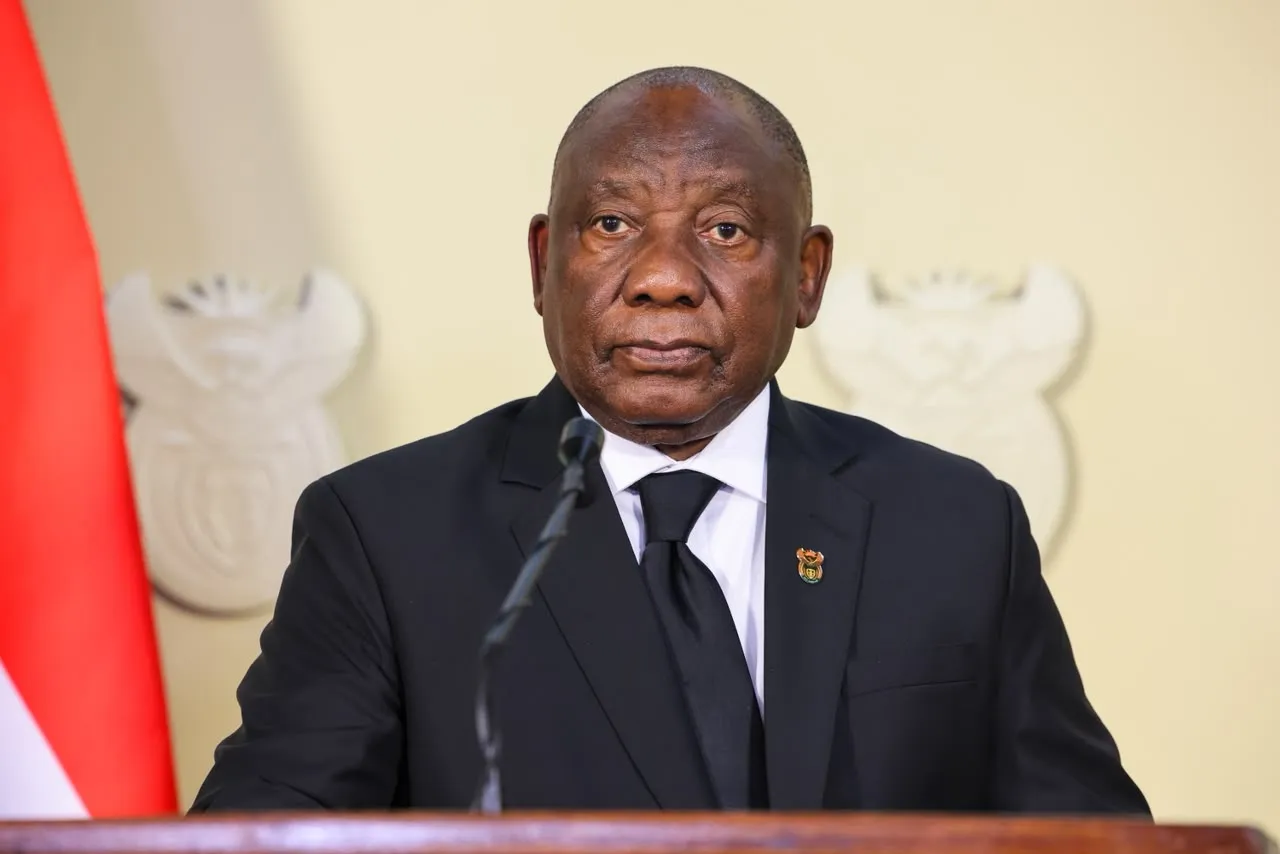

President Cyril Ramaphosa has announced four immediate measures to strengthen South Africa’s response to gender-based violence and femicide. Image: Supplied.
Ekurhuleni
1Min
South Africa
Ramaphosa announces urgent measures to tackle GBVF after Ekurhuleni killings
President Cyril Ramaphosa has announced four immediate measures to strengthen South Africa’s response to gender-based violence and femicide following the discovery of 11 women’s bodies in Ekurhuleni since July.

President Cyril Ramaphosa has announced a series of urgent measures to address gender-based violence and femicide following the discovery of 11 women’s bodies in Ekurhuleni since July.
In an address to the nation on Tuesday, 29 September 2026, Ramaphosa said the killings had received attention at the highest levels of government and law enforcement.
The President said a specialised multidisciplinary investigation had been elevated to the national level under the coordination of the Deputy National Commissioner for Detective Services.
The investigation brings together detectives, Crime Intelligence, forensic specialists, investigative psychologists, digital investigators and other specialised capabilities.
Police have already made arrests in some of the cases. According to Ramaphosa, a suspect was arrested on Sunday in connection with the murder of Ntombifuthi Nxumalo, while two suspects have appeared in court in connection with the killing of Jabulile Ntimba.
A suspect is also in custody in connection with the murder of Busisiwe Mahlangu.
Police have identified persons of interest in other cases and collected forensic material, including DNA, blood samples, clothing, cellphones and cellphone records. The Council for Scientific and Industrial Research (CSIR) is assisting with the digital forensic investigation.
Ramaphosa said police had not found evidence at this stage establishing that the Ekurhuleni killings were committed by a single perpetrator, adding that all possibilities remained under investigation.
The President also appealed to members of the public to report missing people immediately, stressing that there is no requirement to wait 24 hours before making a missing-person report.
Four immediate measures
Ramaphosa announced four measures that he said would be implemented as part of the government’s wider response to GBVF.
The first is a national case-recovery operation focused on unresolved murders, attempted murders, rapes and serious sexual offences involving women and children.
The operation must, within 60 days, identify unresolved cases, cases awaiting forensic evidence, cases where suspects have been identified but not arrested, and cases where investigative or prosecutorial action has been delayed.
Within 90 days, individual recovery plans must be developed for priority cases and stalled cases, setting out the outstanding actions, responsible officials and deadlines.
The second measure targets forensic backlogs. The Minister of Police, the National Commissioner of Police and relevant forensic authorities must present a funded plan within 60 days to reduce backlogs and establish turnaround standards for priority GBV and femicide cases.
Priority forensic samples involving the rape or murder of women and children are to be ring-fenced for urgent processing, with progress reported publicly every quarter.
The third measure requires every municipality to conduct a women's safety audit.
The audits must identify risks such as broken streetlights, overgrown public spaces, abandoned buildings, unsafe transport routes and poorly secured parks and facilities.
Within 90 days of completing the audits, urgent hazards must either be addressed or included in funded implementation plans with completion dates.
The fourth measure involves the development of a coordinated legislative and enforcement package to reduce alcohol-related violence.
Ramaphosa said the package would be developed by the Minister of Trade, Industry and Competition, working with the Ministers of Health, Social Development, Police and Cooperative Governance, and submitted to Cabinet within 60 days.
He stressed that alcohol does not cause GBV and can never excuse violence, saying responsibility remains with the perpetrator. However, he said harmful alcohol use is a significant aggravating factor in interpersonal violence.
The President said the Inter-Ministerial Committee on Gender-Based Violence and Femicide and the National Council on Gender-Based Violence and Femicide would monitor the measures and issue consolidated public progress reports every quarter.
A first consolidated report is expected within 90 days.
Focus on prevention
Ramaphosa said government’s response could not focus only on policing and arrests, arguing that preventing violence before it occurs must also be prioritised.
He said GBV often begins with attitudes that regard women as inferior, attempts to control women, harassment, coercion and the belief that men are entitled to women’s attention or affection.
Citing a national study by the South African Medical Research Council, Ramaphosa said more than 60% of women murdered in 2021 and 2022 were killed by an intimate partner.
He called on men and boys to challenge abusive behaviour and play a greater role in confronting violence against women.
The President also announced that the Minister of Sport, Arts and Culture had been directed to strengthen the work of the Moral Regeneration Movement and ensure that it contributes to changing attitudes, social norms and practices that enable violence against women.
The address comes as South Africa prepares for the annual 16 Days of Activism against Gender-Based Violence campaign later this year.
Ramaphosa said the country needed to move beyond mourning and condemnation towards sustained action to ensure that women and girls can live in freedom, dignity and safety.