
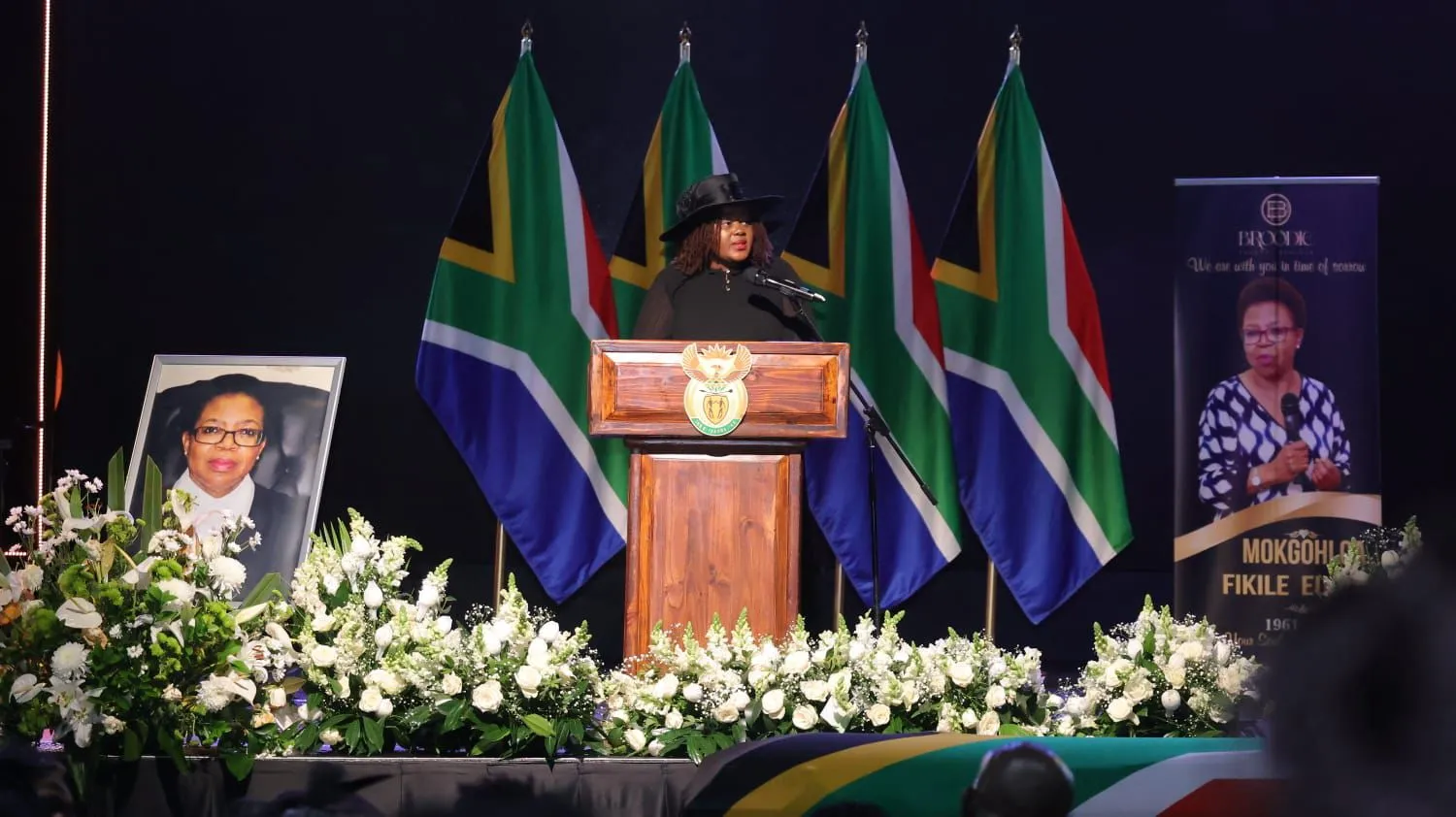

Justice Mokgohloa was honoured with a Special Official Funeral Category 2. Image: X
Supreme Court of Appeal
1Min
South Africa
Justice Mokgohloa remembered as champion of dignity and equality
Justice Minister Mmamoloko Kubayi has paid tribute to the late Justice Fikile Eunice Mokgohloa, saying her judgments helped advance social justice and protect the rights of poor, vulnerable and marginalised South Africans.

Minister of Justice and Constitutional Development Mmamoloko Kubayi has paid tribute to the late Justice Fikile Eunice Mokgohloa, describing her death as a major loss to South Africa’s judiciary and praising her contribution to the development of the country's constitutional democracy.
Justice Mokgohloa was honoured with a Special Official Funeral Category 2 after President Cyril Ramaphosa recognised her distinguished service to the nation and the judiciary.
She died on 20 August 2026 at the age of 65 while serving as a judge of the Supreme Court of Appeal.
Mokgohloa had served on the Supreme Court of Appeal since June 2019, following her tenure as Deputy Judge President of the Limpopo Division of the High Court. She also served as Acting Deputy President of the Supreme Court of Appeal.
Speaking at her funeral in Pretoria on Saturday, Kubayi said Mokgohloa had dedicated her life to building a just society.
“Justice Mokgohloa’s passing is a profound loss to the Judiciary, the legal profession and the people of South Africa,” Kubayi said.
The minister said Mokgohloa’s journey from a young girl growing up during apartheid to becoming a judge of the Supreme Court of Appeal was an inspiration to women and girls across the country.
Born in Pretoria in 1961, Mokgohloa obtained B Juris and LLB degrees before rising through the legal profession in a judiciary that had historically been dominated by men.
Kubayi said her determination and brilliance allowed her to challenge stereotypes and break barriers for women in the legal profession.
She said Mokgohloa understood the transformative nature of South Africa’s Constitution and used the law to advance dignity, equality and social justice.
Judgments that protected vulnerable communities
Kubayi highlighted several judgments delivered by Mokgohloa that had a significant impact on vulnerable communities.
In the Mchunu and Others v Executive Mayor, eThekwini Municipality and Others matter, Mokgohloa ruled in favour of people from informal settlements who had been illegally evicted.
The judgment overturned a temporary court order that had been used to facilitate the eviction of thousands of poor residents in Durban, leaving them homeless.
Kubayi said the ruling represented an important step towards protecting vulnerable communities from the effects of inequality and ensuring that constitutional rights translated into meaningful improvements in people's lives.
She said Mokgohloa's judgments demonstrated her commitment to ensuring that socio-economic rights, including the right to housing and equality, were respected.
Advancing women's rights
The minister also reflected on the TM v ZJ matter, involving a couple married under Islamic law whose marriage had not been registered under the Marriage Act.
The case involved a dispute over custody, maintenance and legal costs during divorce proceedings.
Kubayi said the husband argued that the marriage had already been terminated through the pronouncement of talaq.
However, Mokgohloa found that the wife could not be denied relief under the Marriage Act simply because of the nature of her Muslim marriage.
Kubayi said the judgment demonstrated the importance of balancing religious rights with fairness and the constitutional right to dignity.
She said Mokgohloa's contribution also showed the importance of women judges in bringing valuable lived experiences to the bench and shaping how courts interpret equality and deliver justice.
Kubayi said Mokgohloa would be remembered not only for her legal achievements but for her unwavering commitment to the Constitution and to creating a society where the rights of poor and vulnerable people are protected.
Her legacy, the minister said, would continue to inspire future generations of women and legal professionals.




Social Justice