

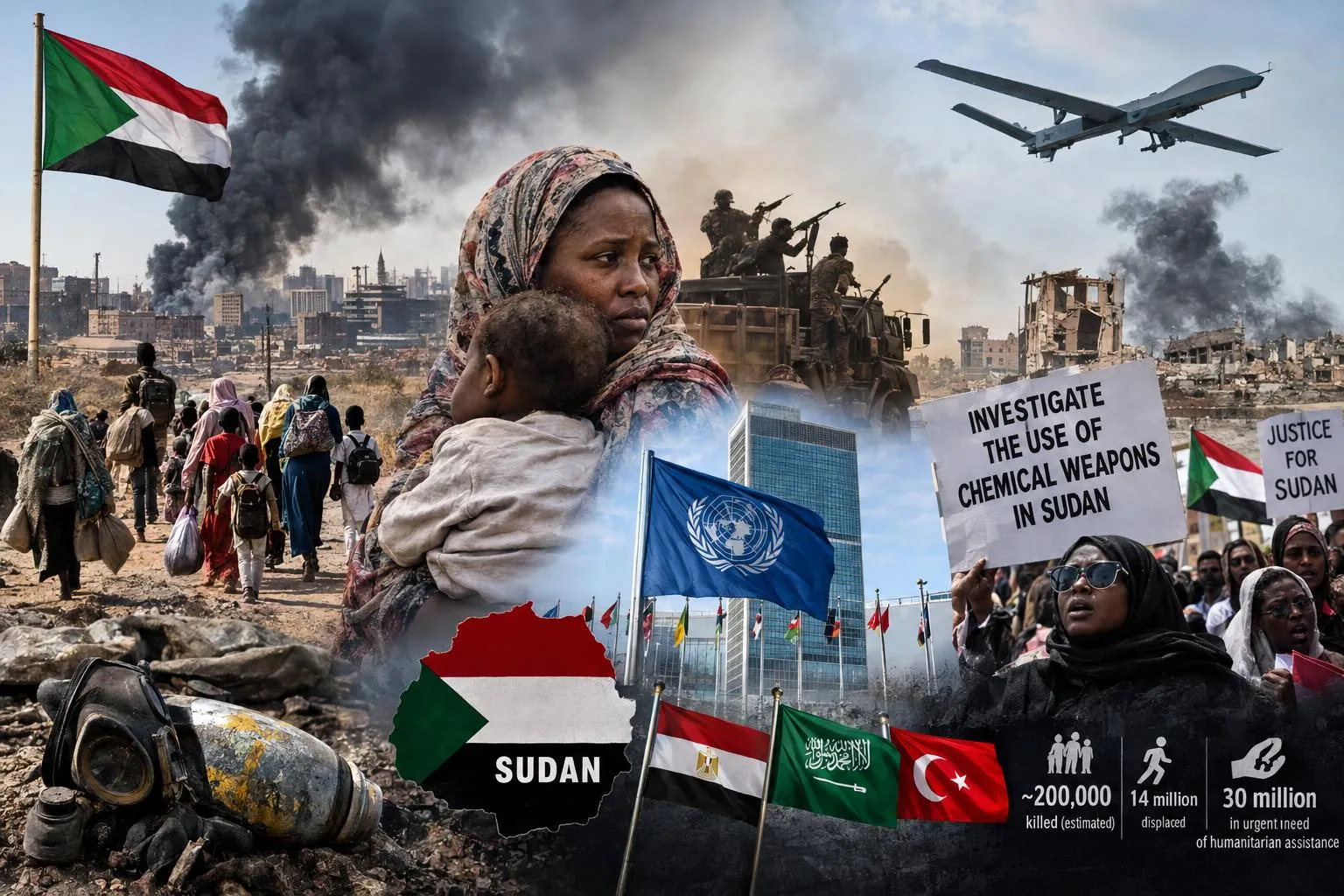
The war has forced more than 14 million people to flee their homes, while more than 30 million civilians are currently in need of urgent humanitarian assistance. Image: AI Generated.
United Nation
1Min
South Africa
Sudan: War amid chemical weapons crimes and awaiting an international response
The war has killed nearly 200,000 people, according to estimates by humanitarian organizations, while regional and international interests have become the main driving force behind the conflict and the fuel that periodically reignites it.

In Sudan, the war has not been limited to the sounds of artillery and drones or the confrontation between the army and the Rapid Support Forces. The war that erupted in mid-April 2023 has turned into an arena for violations of international prohibitions and a proxy war.
The war has killed nearly 200,000 people, according to estimates by humanitarian organizations, while regional and international interests have become the main driving force behind the conflict and the fuel that periodically reignites it.
According to UN estimates, the war has forced more than 14 million people to flee their homes, while more than 30 million civilians are currently in need of urgent humanitarian assistance.
Meanwhile, dozens of Sudanese recently demonstrated outside the United Nations headquarters in Geneva, calling for an international investigation into allegations that the army used chemical weapons and for attention to be drawn to the cost borne by civilians as a result of foreign military support in Sudan’s war. The demonstration coincided with the 63rd session of the United Nations Human Rights Council, hosted in Geneva from September 7 to October 7.
The demonstrators stressed that the current international response must be sufficient to uncover what happened and prevent the repeated use of such weapons, after the United States confirmed that the Sudanese army had used them in the war.
The United Nations announced its readiness to investigate allegations concerning the Sudanese army’s use of chemical weapons in the war, amid growing calls for an independent international investigation to establish the truth of what happened, protect civilians and prevent the use of internationally prohibited weapons.
Stephane Dujarric, spokesman for UN Secretary-General António Guterres, told The National, in response to a question about establishing a fact-finding mission to enter Sudan and investigate the alleged use of chemical weapons: “If we are given a mandate to do that, we will.” He added: “It is abhorrent that, in the 21st century, we are still talking about chemical weapons, after we witnessed the atrocities they caused during World War I, the way Saddam Hussein used them against his own people, and the way they were used in Syria. We should not be talking about chemical weapons, and no one should use them.”
Compelling Evidence and Limited Action
The Sudanese army violated Sudan’s international obligations, as Sudan has been a state party to the Chemical Weapons Convention since 1999. Nevertheless, it used chemical weapons during the ongoing war, according to the United States, which imposed sanctions on Sudan as a result in May 2025.
Washington renewed its accusations against the army before the 112th session of the Executive Council of the Organisation for the Prohibition of Chemical Weapons in The Hague last July. It said the Sudanese army had used chemical weapons during 2024 and considered Sudan to remain non-compliant with the Chemical Weapons Convention in 2025. It added that, following a “rigorous and independent technical analysis,” it had concluded that the Sudanese government had used chemical weapons during 2024 and had remained non-compliant during 2025.
In September 2026, the American newspapers The Washington Post and The New York Times revealed investigative information based on classified documents indicating that the Sudanese army had established a stockpile of chemical weapons, including the production and development of munitions and bombs containing chlorine gas, and that it had used them against the Rapid Support Forces during the ongoing war, while the army denies these allegations.
Despite this, the independent international investigation remains limited in comparison with the gravity of the allegation. The Organisation for the Prohibition of Chemical Weapons is the specialized international body capable of carrying out technical verification operations, while Port Sudan submitted a national investigation that concluded that no evidence had been found proving the use of chemical weapons. The United States rejected the national mechanism as a substitute for independent international verification.
Regional Presence and the War
The demonstration organized by protesters in Geneva focused primarily on civilian suffering and foreign interventions in the war, as well as the risks civilians face as a result of the flow of weapons and the continuation of fighting.
This highlights Egypt’s role in the war. Egypt had served as a mediator in international initiatives to end the conflict, but it has shifted to supporting the army, amid concerns that parts of the north, central and east of the country could join it in the coming decades.
The airstrikes attributed to Egypt against the Rapid Support Forces on January 9 revealed a pivotal shift, marking a dividing line between months of cautious diplomacy and the beginning of a new phase in Cairo’s position.
Reuters reported last November that a powerful model of Turkish combat drones had been deployed on an airstrip on Egypt’s southwestern border, while satellite images from Vantor, a US company specializing in space technology, showed a large drone on the runway of one of the airports in East Oweinat on September 29, December 28 and January 9.
In the same context, The New York Times also published images of Akıncı drones at East Oweinat Airport, which it reported were being used to carry out strikes in Sudan.
The Akıncı is one of the most advanced drones produced by Turkish defense company Baykar, with the ability to fly at high altitudes, remain airborne for 24 hours and carry a wide range of munitions.
Saudi Arabia Changes Its Positions
According to publicly available information, Saudi Arabia’s recent moves in Sudan come as part of Riyadh’s efforts to stabilize its southern neighborhood and protect its vital interests in the Red Sea.
Saudi Arabia, which began its efforts with the Jeddah talks, has moved beyond the development dimension, politically aligning itself behind Burhan and hosting him in Riyadh, along with those close to him.
On March 28, 2025, Crown Prince Mohammed bin Salman received the Chairman of Sudan’s Sovereignty Council at Al-Safa Palace in Mecca. The two sides agreed to establish a joint coordination council to strengthen cooperation in the economic, security and development fields. Meanwhile, available information indicates that Saudi support for Burhan goes beyond the development dimension, forming part of a broader geopolitical strategy aimed at managing regional balances in the Horn of Africa and the Red Sea.
Rather than remaining merely a mediator between two equal parties, Riyadh’s political positions have begun to reflect greater interest in Burhan’s camp. Reuters revealed that Saudi Arabia may have mediated a Pakistani arms deal for the Sudanese army worth around $1.5 billion, after which Riyadh requested the cancellation of the deal and informed Islamabad that it would not finance it.
According to Saudi officials, Riyadh views Sudan as lying on the opposite shore of the Red Sea and in close proximity to Saudi maritime borders. The stability of its ports and coastline is also directly linked to the security of navigation, energy and trade in the Red Sea.
Turkey, meanwhile, has become associated with decisive shifts in the balance of wars through its drones. According to journalistic investigations, Turkey took the initiative to supply the Sudanese army with advanced weapons, particularly drones that have contributed to the deaths of thousands of civilians and the destruction of the country’s infrastructure.
The Washington Post revealed in March 2025 documents, communications, commercial records and flight records that it said documented the arrival of Turkish-made weapons and drones to the Sudanese army.
The Sudanese Defense Industries System signed a contract worth around $120 million with Turkish company Baykar to provide drones and munitions. The shipments arrived in Sudan in 2024, with Turkish technicians present to assist in operating the equipment. Ankara, meanwhile, denied providing military support to either side in the war, according to the newspaper’s investigation.
Fueling the War
During September 2026, the United Nations Independent International Fact-Finding Mission for Sudan said that the recruitment of foreign nationals and external support networks were contributing to fueling the war in Sudan, strengthening the military capabilities of the parties to the conflict and enabling them to conduct increasingly sophisticated military operations, with devastating consequences for civilians.
According to the report, states connected to these supply chains have strict international legal obligations requiring them to exercise due diligence, investigate and halt illicit mercenary and supply networks operating from or through their territories, prevent violations, and enforce the UN arms embargo.