

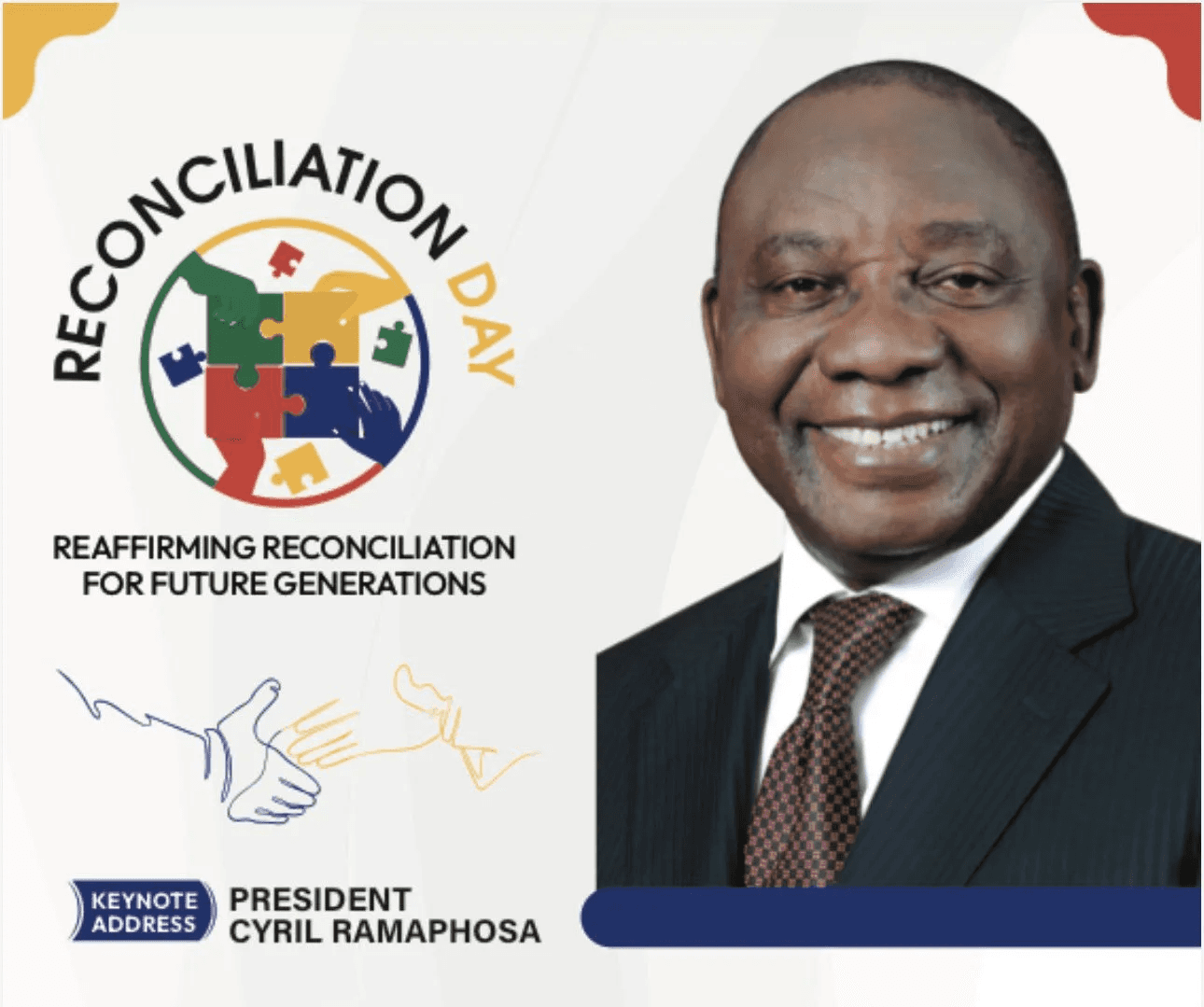
President Cyril Ramaphosa delivering the keynote address at the national commemoration of Reconciliation Day currently underway in Ncome Museum, Nquthu Local Municipality, in the uMzinyathi District of KwaZulu-Natal. Image:X
KwaZulu-Natal
1Min
South Africa
Ramaphosa champions reconciliation amid tensions with the US
The recent Reconciliation Day ceremony saw President Cyril Ramaphosa tackle strained US relations while celebrating the strides made in unity among South Africans, reinforcing the nation's commitment to healing and togetherness in the face of adversity.
President Cyril Ramaphosa has emphasised the importance of unity and resilience among South Africans, while confronting the challenges posed by fraught relations with the United States.
The annual commemoration took place at the Ncome Museum in KwaZulu-Natal, serving as a platform not only for reflection on the past but also for recommitting to the ideals of reconciliation fostered by Nelson Mandela.
Themed “Reaffirming Reconciliation for Future Generations,” this year’s event echoed the sentiments of inclusivity and healing that have characterised South Africa's journey since the dawn of democracy in 1994. Ramaphosa urged citizens to embrace their shared identity as South Africans and to acknowledge the strides made in race relations over the last three decades.
“Commemorating the 16th of December provides us with an opportunity to confront our past with honesty, acknowledge the complexities of our shared history and commit ourselves to building a peaceful future together,” he stated. “Our democracy was built on reconciliation.”
Ramaphosa’s speech resonated with the public, as it called attention to the misconceptions surrounding South Africa’s progress. He lamented the portrayal of the nation by both domestic and international critics, who, he argued, ignore the positive narratives that underscore harmonious interactions between diverse racial groups. Citing examples of unity, from children learning together to cross-cultural friendships, he asserted that these themes often get overshadowed by negative commentary.
The backdrop of Ramaphosa's speech included the recent exclusion of South Africa from the upcoming 2026 G20 Summit by the U.S., which cited apprehensions regarding violence against the white Afrikaner minority and controversial land policies.
This exclusion raised eyebrows, especially following South Africa's successful hosting of the G20 Summit, culminating in a comprehensive 122-point Johannesburg Declaration last month, which stressed pressing issues like conflict resolution and climate change.
In a demonstration of support for South Africa, China recently chastised the U.S. decision and reaffirmed its commitment to continued cooperation, amid evident diplomatic strains that have arisen. Ramaphosa reiterated that the South African government remains undeterred and poised to navigate these challenges.
“We reconciled in 1994. We are still reconciling in 2025,” he added. “There are those, inside and outside our country, who are trying their utmost to paint a false picture of us as the South African people.”
The president's remarks received a warm reception from KwaZulu-Natal Premier Thami Ntuli and Minister of Sport, Arts and Culture Gayton McKenzie, who were present at the commemoration led by the Department of Sports, Arts and Culture and the provincial government.
In the spirit of reconciliation, Ramaphosa called on citizens to resist the narratives aimed at sowing division and hatred, urging them to focus on the strength of South African society, which embodies communal living and shared aspirations. As the nation marks another Reconciliation Day, the call for unity remains poignant and urgent, as South Africa strides ahead on its path to healing and nation-building.