


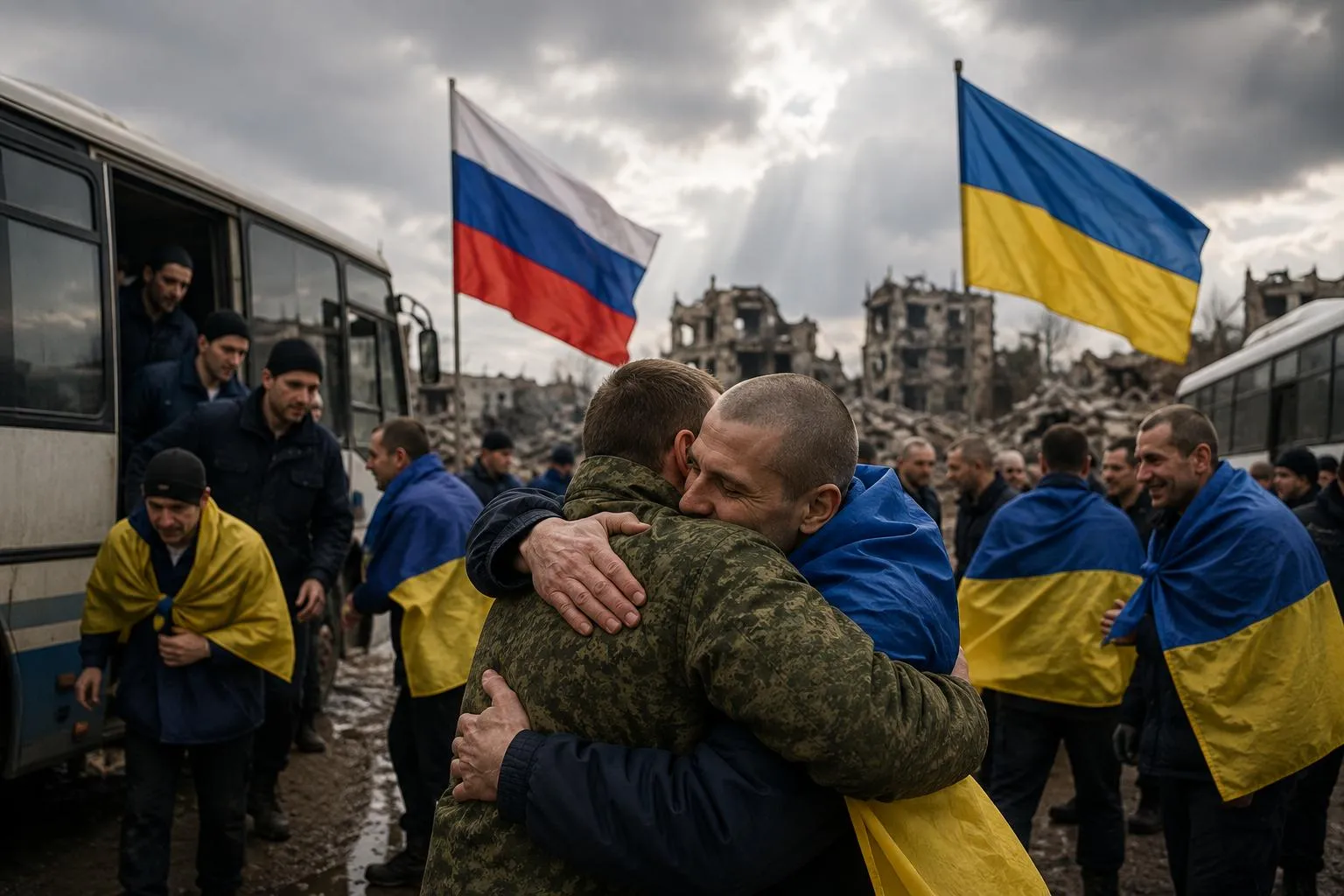

A UAE-mediated prisoner exchange involving 206 detainees has offered a rare sign of continued communication between Russia and Ukraine. Image: AI Generated
Ukraine
1Min
South Africa
Prisoner swap keeps a narrow diplomatic bridge open between Russia and Ukraine
A UAE-mediated prisoner exchange involving 206 detainees has offered a rare sign of continued communication between Russia and Ukraine as battlefield tensions intensify and prospects for a wider political breakthrough remain uncertain.

A new prisoner exchange between Russia and Ukraine has highlighted the fragile diplomatic channels that remain open despite continued military escalation and deepening political tensions between the two sides.
The United Arab Emirates announced on Wednesday that it had successfully mediated the exchange of 206 prisoners, with 103 detainees released by each side.
The latest operation marks the 26th prisoner exchange facilitated by the UAE since the start of its mediation efforts, with about 8,000 prisoners reportedly involved in the exchanges.
The agreement comes as Russia and Ukraine continue to trade attacks and struggle to make meaningful progress towards a broader political understanding over the future of the war.
The prisoner exchange itself had faced obstacles in the days leading up to the latest agreement. According to Reuters, Moscow and Kyiv had accused each other of hindering exchange efforts and disagreed over lists of detainees.
The dispute underscored how even humanitarian arrangements remain vulnerable to the wider tensions surrounding the conflict.
Russia’s Defence Ministry confirmed that the latest exchange was mediated by the UAE, while the UAE Ministry of Foreign Affairs said cooperation between the two sides had made the operation possible.
Abu Dhabi has increasingly positioned itself as a mediator between the parties, facilitating multiple prisoner exchanges and hosting talks involving Russia, Ukraine and the United States.
While such humanitarian agreements do not amount to peace negotiations, they provide one of the few areas where Moscow and Kyiv have continued to engage despite the deterioration of relations.
The survival of these channels could prove significant if circumstances eventually create space for wider discussions aimed at reducing hostilities.
For now, the prisoner exchanges demonstrate that limited cooperation remains possible even as the broader conflict continues.
The UAE’s role could therefore become increasingly important in future diplomatic efforts, particularly if Russia and Ukraine eventually move from managing the humanitarian consequences of the war towards negotiations on de-escalation or a broader political settlement.