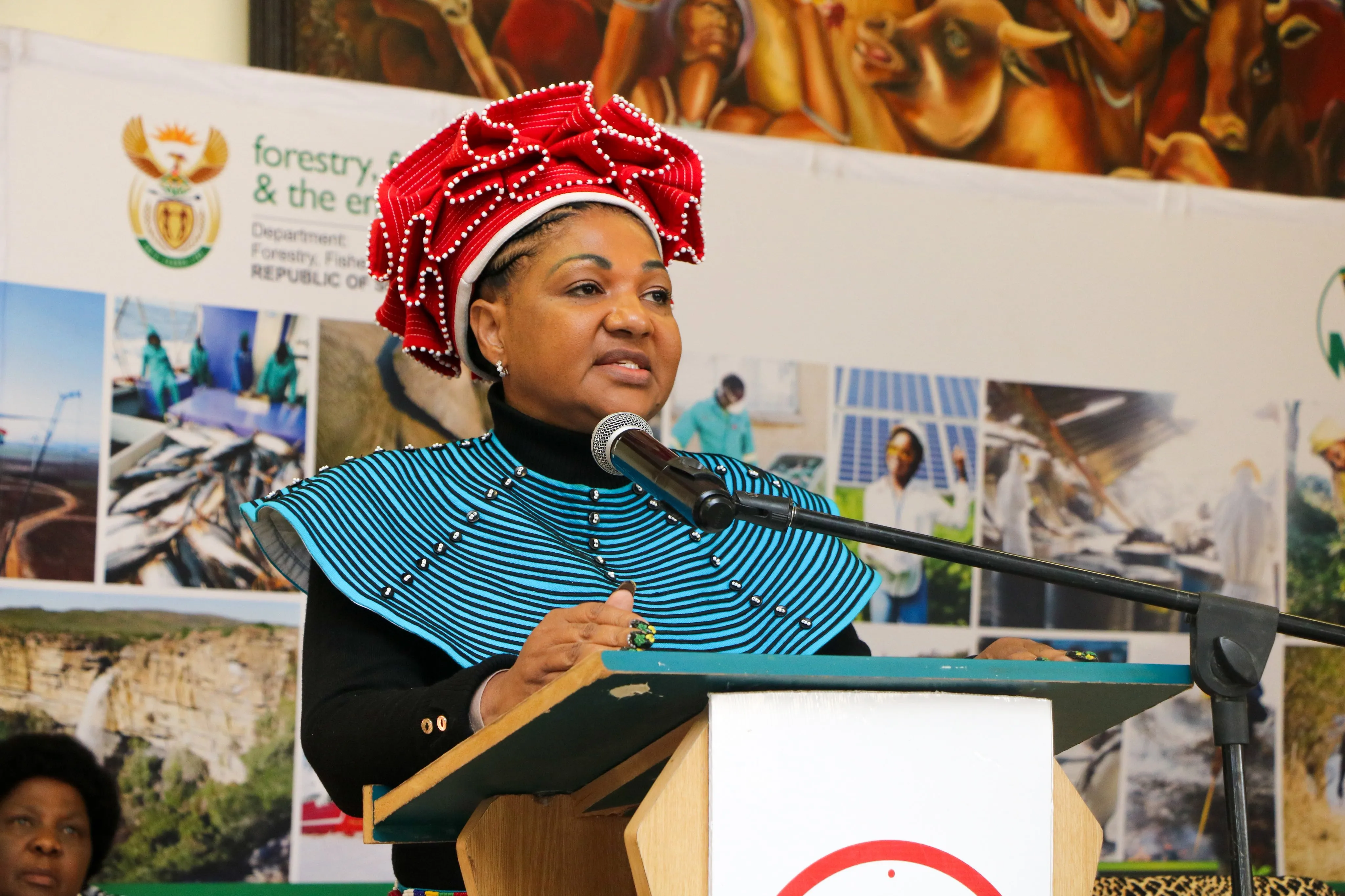

Deputy Minister Bernice Swarts said the department is working to ensure communities receive the necessary support to manage the plantations successfully. Image: Supplied.
Eastern Cape
1Min
South Africa
Government hands over state plantations to Nqadu communities to boost forestry and rural development
The Department of Forestry, Fisheries and the Environment has transferred seven state plantations to beneficiary communities in the Eastern Cape's Nqadu area, with more transfers planned this financial year as part of efforts to expand community participation in the forestry sector and create sustainable rural livelihoods.

The Department of Forestry, Fisheries and the Environment (DFFE) has handed over the management of seven state plantations to beneficiary communities in the Nqadu area of the Eastern Cape, marking a significant step towards empowering rural communities through forestry.
A further four plantations are expected to be transferred before the end of the current financial year.
Speaking at the Nqadu Great Place during a nature-based carbon dioxide removal and rural development event, Deputy Minister Bernice Swarts said the department is working to ensure communities receive the necessary support to manage the plantations successfully.
To strengthen their capacity, the DFFE is facilitating partnerships between beneficiary communities and established forestry companies. These partnerships will provide investment, technical expertise, skills development and improved access to markets.
"We anticipate concluding these partnerships before the end of this financial year," Swarts said.
She emphasised that while transferring plantations is an important milestone, communities also require technical, financial and business support to operate commercially sustainable forestry enterprises.
Swarts said the Eastern Cape remains one of South Africa's priority provinces for forestry expansion, with more than 100,000 hectares identified as suitable for afforestation, subject to technical assessments, market demand and strategic partnerships.
She added that collaboration with the Nqadu Kingdom could unlock opportunities to bring more land into production, creating jobs during plantation establishment while supporting downstream industries such as timber processing, furniture manufacturing and biomass energy.
As part of government's climate change mitigation efforts, Swarts announced that the department will donate 2,000 indigenous and fruit trees to the Nqadu Kingdom. A total of 750 indigenous trees have already been delivered, while the remaining 1,250 fruit trees are expected to be distributed by 15 August 2026.
The initiative forms part of the Presidential One Billion Trees Programme, launched under the National Greening Programme, which aims to plant one billion trees over five years.
Swarts said the department and its partners planted more than 1.3 million trees in a single day on 24 September 2025 and are now targeting the planting of 10 million trees nationwide on 24 September 2026.
She also highlighted six successful community projects implemented across the Eastern Cape under the Global Environment Facility. The projects have restored degraded land, promoted indigenous tree planting, strengthened agroforestry, improved food security and created temporary employment while equipping rural communities with valuable skills.
The Deputy Minister further encouraged the Nqadu Kingdom to partner with government on introducing community-based electronic waste recycling initiatives.
She said the department's national E-Waste Programme has already collected more than 108 tonnes of electronic waste and generated approximately R400,000 in incentives for participating communities.
Swarts said expanding similar initiatives to the Nqadu Kingdom could create green jobs, particularly for young people and women, while helping protect the environment.