
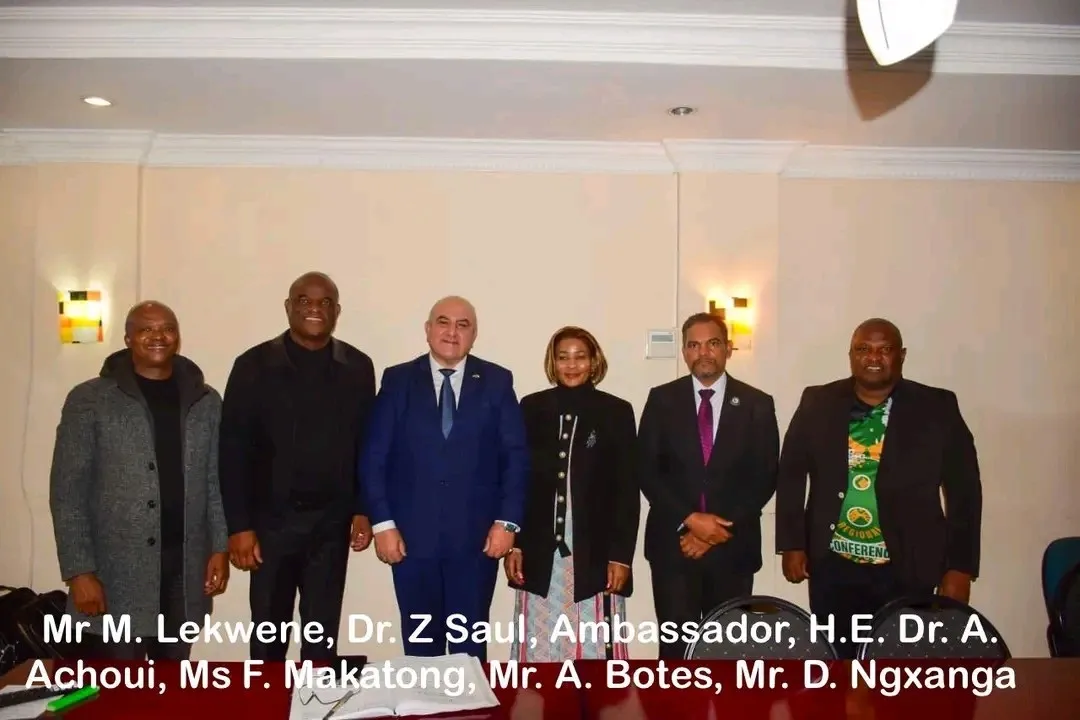

The ambassador was accompanied by ANC NEC member and Deputy Minister of International Relations and Cooperation Alvin Botes. Image: aSuppli
South Africa
Fanon’s warning for South Africa: ANC leader draws lessons from Algeria’s Liberation struggle
Northern Cape ANC chairperson Dr Zamani Saul argues that Frantz Fanon’s revolutionary ideas and Algeria’s liberation history offer a powerful warning for post-apartheid South Africa, particularly on economic inequality, elite capture and the unfinished struggle for meaningful transformation.

The legacy of Algeria’s fight against colonialism and the revolutionary ideas of Frantz Fanon remain deeply relevant to South Africa’s ongoing struggle for economic transformation, according to Northern Cape ANC chairperson Dr Zamani Saul.
Saul reflected on Fanon’s influential book, The Wretched of the Earth, following a meeting between ANC Northern Cape provincial leaders and Algeria’s ambassador to South Africa, Ali Achoui, in Kimberley.
The ambassador was accompanied by ANC NEC member and Deputy Minister of International Relations and Cooperation Alvin Botes.
In his analysis, Saul traced the historical relationship between Algeria’s liberation struggle and South Africa's fight against apartheid, arguing that Algeria played a significant role in inspiring liberation movements across the continent.
Algeria's National Liberation Front led a bloody war against French colonial rule from 1954, eventually securing independence in 1962. The country later provided support to liberation movements, including South Africa's armed wing, uMkhonto weSizwe.
Saul noted that Nelson Mandela travelled to Algeria in 1962 to receive military training and gain insights into revolutionary warfare.
Mandela would later describe Algeria's influence on his development as a liberation fighter, famously saying the Algerian army had “made me a man”.
Fanon's ideas still resonate
Fanon, a Martinique-born psychiatrist and revolutionary thinker, died in 1961 as The Wretched of the Earth was published. The book went on to become one of the most influential works on colonialism, liberation and post-colonial politics.
Saul argues that Fanon's analysis of colonial societies remains visible in South Africa's geography today.
Fanon described colonial societies as divided worlds, separating wealthy and developed areas from impoverished communities occupied by the colonised majority.
According to Saul, apartheid spatial planning reproduced precisely this division through laws such as the Group Areas Act and the Native Land Act.
While South Africa has achieved political freedom, he argues that many of the country's townships and rural communities remain economically marginalised, while historically privileged centres continue to accumulate wealth.
“The spatial division has proven remarkably resilient,” Saul argues, pointing to persistent inequality between wealthy urban areas and underdeveloped communities.
A warning about liberation movements
However, Saul says Fanon's most important contribution may be his warning about what happens after liberation movements take power.
In The Pitfalls of National Consciousness, Fanon warned that newly independent countries could replace colonial rulers without fundamentally changing the economic structures that produced inequality.
Saul argues that this warning has particular relevance for post-apartheid South Africa.
He criticises the emergence of politically connected elites who benefit from state contracts, corporate positions and empowerment deals without contributing to broader industrial development.
Saul argues that some transformation policies, including aspects of Black Economic Empowerment, have at times benefited a small elite instead of fundamentally restructuring the economy.
He says this has contributed to growing frustration among young people facing unemployment, poverty and inequality more than three decades into democracy.
Economic freedom remains unfinished
Saul warns that continued economic exclusion could weaken public confidence in democratic institutions and create fertile ground for populist politics.
He argues that political liberation without meaningful economic transformation remains incomplete.
The challenge facing South Africa, Saul concludes, is to build a capable and ethical state that can drive industrialisation, planning and economic transformation while avoiding corruption and elite capture.
Drawing inspiration from Fanon and Algeria's liberation history, Saul says South Africa must confront the difficult question of whether it has the political courage to fundamentally transform an economy whose inequalities continue to mirror the country's colonial and apartheid past.
For Saul, Fanon's message remains clear decades after The Wretched of the Earth was published: winning political power is only the beginning — the real test of liberation lies in transforming the lives of the people who fought for freedom.