


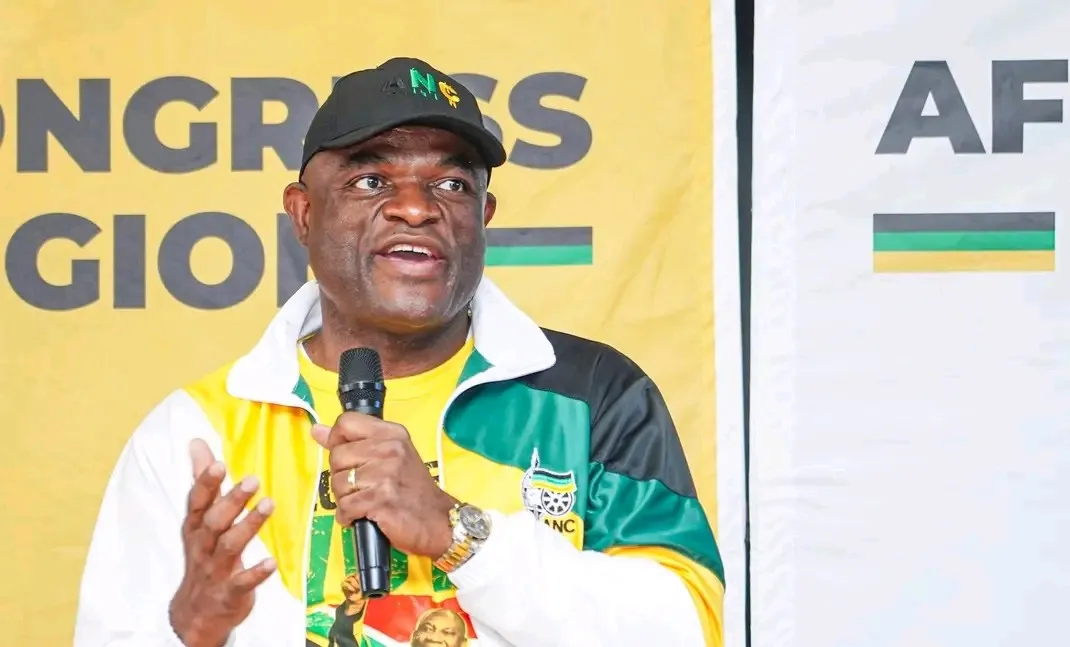

Political elitism is found all over, it is there in non-COSATU affiliated unions such as AMCU and NUMSA. Image: Supplied
ANC
Cosatu congress collapse blamed on political gridlock
Political elitism is found all over, it is there in non-COSATU affiliated unions such as AMCU and NUMSA. The news report on Joseph Mathunjwa, the AMCU President, and Irvin Jim, NUMSA General Secretary, reflect that their opulent lifestyles and luxury choices contradict their revolutionary rhetoric.

The First Deputy President of COSATU, Mike Shingange, might be correct in this video clip, asserting that "from where I stand, there is a government of an elite pact, what they call as the Government of National Unity”. Emphatically, he concludes “That thing there is an elite pact".
Ironically, the continued weakening of the glorious federation of the workers, COSATU, into a laughing stock is due to the evolution of union leaders into political elites. Let me start by acknowledging that political elitism is a pathology of modern political parties and trade unions and is deeply embedded in all the Alliance components, including COSATU.
Political elitism is found all over, it is there in non-COSATU affiliated unions such as AMCU and NUMSA. The news report on Joseph Mathunjwa, the AMCU President, and Irvin Jim, NUMSA General Secretary, reflect that their opulent lifestyles and luxury choices contradict their revolutionary rhetoric.
These are worker leaders with top of the class luxury accommodation in the most affluent areas and armoured fleet of cars. This is a textbook case of political elitism that can never be hidden through radical rhetoric. Workers in these two unions are quite aware of this, but remain helpless, as union leaders tend to deploy banditry activities to sustain their political elitism.
These banditry activities include marginalisation, isolation and sometimes threats of violence against their opponents. There is nothing that closely resembles commitment to socialism with such union leaders, but only a loosely packed left-wing radical rhetoric by show-men and not revolutionary worker leaders.
At the heart of the credentials chaos that led to the collapse of COSATU's 15th National Congress is political elitism that defines the fabric and texture of union leaders, who have evolved to be unfamiliar with factory fumes, mining dust and shop-floor struggles. This political elitism, is now more destructive when spiced up with the ANC/SACP gridlock.
The ANC/COSATU gridlock is the contradiction generated by the decision of the SACP to independently contest the 2026 Local Government elections and future elections. This contradiction inevitably spilled-over to COSATU and was punctuated by public pronouncements by its affiliates on which of the two parties they will support during the forthcoming local government elections. This opened a fierce ANC/SACP contestation for COSATU’s support. This is because support by COSATU will have significant implication for the electoral fortunes of either of the parties.
Despite all the insults, I still maintain the argument that if we had a vanguard SACP that was not captured by an ultra-left sectarian clique, the party would have foreseen the inherent dangers of the decision to independently contest the elections. The decision placed COSATU in a precarious and unenviable position.
Over a century, trade union leaders were produced in the bitter fires of working-class factory-floor struggles. Hence, union leaders were projected as standard-bearers for militant collective will of exploited workers.
This article argues that the perception that union leaders in South Africa are militant is wrong and at odds with reality. Across the globe and with peculiar intensity in South Africa, a profound evolution has occurred. This article further argues that the contemporary trade union leaders are no longer workers who happens to represent other workers; they are members of an entrenched and detached political elite.
Trade union leaders no longer operate on the margins of power; they have become political elites that serve as vital pillars of the modern political establishment. They command massive financial portfolios, broker state policy at the highest levels and treat the factory floor not as a home, but as a launchpad for political ambitions. Unions have been transformed into a political platforms designed to produce, protect and project these political elites.
Transition from Militant Union Leaders into Political Elites
The transition of union leaders from workplace representatives to political elites is neither a recent aberration nor a geographical accident. It is an inescapable consequence of evolution and gradual organisational changes, first identified by the German sociologist Robert Michels in 1911 as the "Iron Law of Oligarchy". Michels observed that even the most radical organisations, specifically citing socialist parties and trade unions, inevitably develop a political elite.
The moment a worker steps off the factory floor, into a permanent union office, their material reality alters fundamentally. They no longer breathe toxic fumes or face the daily indignity of exploitation; they occupy air-conditioned offices, draw secure salaries funded by worker levies and spend their days with corporate executives and state bureaucrats.
The history of unions in Britain, America and former Soviet Union give stark examples of the evolution of union leaders from being militant vanguards of the workers to political elites who are preoccupied with internal squabbles and fights over union investments arms and fund management.
The British Experience
Historically, the evolution from union leaders into political elites manifested clearly in Western Europe, most particularly in Great Britain, the cradle of industrial trade unionism. The late 19th and early 20th centuries saw the Trades Union Congress (TUC) transition from a federation of radical affiliates into an elite formation. The creation of the Labour Party in 1900 was a political strategy by union leaders to secure direct influence into government.
This trajectory became a career path. Union leaders bargained with the state not as an external interest group, but as internal stakeholders of the political system. By the 1970s, during the "Social Contract" era, TUC leaders were dubbed the "real rulers of Britain", dictating national macro-economic policy, inflation targets and price controls directly to Downing Street. When their careers as union leaders ended, these so called “champions of the workers” routinely retired to the red benches of the House of Lords as barons and knights, fully integrated into the British political elite.
The American and Soviet Models
In the United States, the trajectory took a more overtly form of evolution of union leaders . The American Federation of Labour (AFL)pioneered "business unionism". American union leaders explicitly rejected class struggle in favour of operating unions within the capitalist system.
American union leaders wielded power that rivalled Wall Street CEOs, controlling massive pension funds that were used to finance Las Vegas casinos and buy political influence. The American union leader became a political boss in the truest sense, trading bloc votes and campaign financing for legislative favours.
Conversely, within the Eastern Bloc, the integration of union leaders into the political elite achieved its peak. Under Soviet-style state socialism, trade unions were explicitly designated by Vladimir Lenin as "schools of communism" and transmission belts of the Bolshevik Party. Leaders of the All-Union Central Council of Trade Unions enforced production quotas and suppressed industrial unrest on behalf of the state.
Whether under Anglo-American capitalism or Soviet socialism, history confirms that the evolution of trade unions converges on a singular point, which is the transformation of union leaders into an elite cadre whose primary allegiance is to narrow self-propelled interests, rather than the interests of the rank-and-file workers.
Evolution of South Africa’s Union Leaders into Political Elites
Nowhere is the reality of the trade union leader as a political elite more starkly illustrated, or more socially consequential, than in South Africa. The history of contemporary South African labour is inextricably bound to the struggle against apartheid. During the 1970s and 1980s, black trade unions, most notably organised under the Congress of South African Trade Unions (COSATU) founded in 1985, became the domestic engine of the liberation struggle while the ANC was banned and exiled.
Historically, this role was encapsulated in what was known as "strategic unionism": the view that workers are first and foremost members of the community before they are workers. If the community is oppressed, workers are obliged to play an active and principal role in fighting that oppression; the militancy of the workers must therefore go beyond the factory gate into communities and the broader struggle for liberation.
This historic role, however, laid the foundation for the creation of a uniquely powerful union leadership. This designated “strategic unionism”role of COSATU as opposed to “narrow workerist struggles” underpinned its involvement in the Tripartite Alliance, alongside the ANC and the SACP. This Alliance arrangement became a direct conveyor belt from the union boardroom to the corridors of state power. Just as with the TUC in Britain and the AFL in the United States, the most prominent union leaders were most likely to secure powerful government positions upon exiting union politics.
South Africa followed a similar trajectory as TUC and AFL as there is inexhaustible list of prominent union leaders who were or are equally members and leaders of the ANC who got deployed into government positions. The current President Cyril Ramaphosa was the co-founder and the first General Secretary of the powerful NUM. Kgalema Motlanthe also served as the General Secretary of NUM and later served as President. Jay Naidoo, the iconic first General Secretary of COSATU was Minister without Portfolio and later became the Minister of Posts, Telecommunications and Broadcasting. Alec Erwin the prominent leader within the Federation of South African Trade Unions (FOSATU) and NUMSA served as Minister of Trade and Industry and later as Minister of Public Enterprises. Gwede Mantashe served as the General Secretary of NUM and is now the Minister of Mineral and Petroleum Resources. The list is unending, very long and includes, amongst others, Enoch Godongwana, Thulas Nxesi, Ebrahim Patel, Mondli Gungubele, Nathi Nhleko, Noluthando Mayende-Sibiya and Fikile Majola.
Investment Arms of South African Unions Fuel Political Elitism
What also gives rise to political elitism of union leaders is the establishment of investment arms by unions. These investment arms get repurposed to facilitate and sustain gravy-train lifestyle of union leaders. This reinforces the status of union leaders with immense and opaque economic power. Modern South African trade unions are not merely member-funded non-profit organisations. Differences among union leaders are seldom about the class interest of the workers, but more about control of the investment arms.
Through their investment arms; unions are massive financial enterprises such as, amongst others, Kopano ke Matla (COSATU’s investment arm), HCI (Hosken Consolidated Investments, born out of the Southern African Clothing and Textile Workers Union) and the Mineworkers Investment Company (MIC) of NUM with interest in mining services, financial capital and telecoms. The union political elite controls billions of rands in assets spanning media, gambling, transport, property and mining.
This commercialisation creates a fundamental contradiction that detach the union elites from the rank-and-file workers. When a union's investment arm owns substantial shares in a commercial enterprise, the union leaders' material interests align with capital objectives of efficiency, profitability and cost-containment. This presents an antithesis of worker demands for higher wages and shorter working hours.
In this union venture investments environment, the classic definition of union leadership undergoes a fundamental shift; leadership commitment moves away from militant representation of workers towards political elitism. This dynamic creates a deep conflict of interest, transforming union leaders into institutional investors who are dependent on corporate profitability to sustain their portfolios, rather than prioritising the immediate demands of workers.
To understand the modern union leader is to understand the balance sheet of the union's investment arm. When a trade union controls massive asset portfolios, its leadership is bound to think like asset managers. They are bound by fiduciary duties, preoccupied with return on investment, asset diversification and market volatility.
These investment arms create a profound paradox. If a union investment arm owns substantial shares in hospitality, mining or retail sectors, a prolonged strike by its own members directly damages the union's corporate dividends. As a result, contemporary union leaders increasingly utilise their organisational authority to suppress labour unrest and militancy. They manage industrial anger not to defeat capital, but to stabilise it, ensuring that the corporate machinery generating their investment returns continues to run smoothly. Under these circumstances union leaders become pressure valves.
The Collapse of the 15th Congress is a Symptom of Decay of Trade Unionism
The spectacular chaos and subsequent collapse of the COSATU 15th National Congress at Gallagher Estate is a direct consequence of organisational decay. The total collapse of the federation's highest decision-making body was not a random administrative failure, nor was it a healthy manifestation of democratic debate. It was a vivid symptom of a deeper, systemic sickness; which is due to union leadership that has completely evolved into a political elite, entirely detached from the shop-floor realities of the workers they claim to represent.
As 1,820 delegates gathered in Midrand, the country was facing staggering unemployment, aggressive corporate retrenchments and a punishing cost-of-living crisis. Yet the entire national congress gridlocked and degenerated into shouting matches, insults and legal stand-offs. The deadlock did not occur over strategies to fight job losses, minimum wage defaults or worker exploitation. Instead, the congress imploded over a vicious, localised boardroom war regarding the precautionary suspension of First Deputy President Mike Shingange by his home union, NEHAWU.
The friction was fundamentally an elite turf war over who would inherit the federation's presidency and control its proximity to state power and investment wealth. NEHAWU had suspended Shingange to block him from signing nomination forms, clearing the path for an aligned faction to take over the executive. In retaliation, powerful affiliates like the National Union of Mineworkers (NUM) and the South African Municipal Workers Union (SAMWU) effectively held the entire congress hostage by withholding credentials and starving the floor of a quorum.
When delegates are reduced to calling one another "ancestors" and "illiterates" while corporate executives look on, the veneer of worker solidarity is permanently shattered. The congress collapse proved that the modern COSATU leadership views the national congress not as a forum to engineer working-class struggles. While the leaders fought over titles and legal technicalities, the thousands of workers who funded their travel, accommodation and stipends through monthly dues were left completely unrepresented. It was the ultimate historical confirmation that the transition from worker leaders to political elite is complete.
The Role of Union Leaders in Enforcing Stability for Capital Accumulation
In contemporary democratic societies, the primary function of a trade union leader is no longer the liquidation of capitalism, but its stabilisation. Modern states tolerate and institutionalise trade unions precisely because they act as mechanisms of containment of workers’ militancy. Through highly formalised collective bargaining frameworks, such as South Africa's National Economic Development and Labour Council (NEDLAC), union leaders sit down with organised business and state representatives to manage labour unrest.
In these forums, the union leader acts as a trusted pressure valve. Their role is to transform the volatile industrial discontent, unpredictable anger of the workplace into predictable, legally binding, multi-year wage agreements. If workers engage in unprotected, spontaneous strikes, it is most likely the union leaders that are deployed by the system to restore order, instructing the rank-and-file to return to work. Union leaders have become an essential pressure-valve for the state and capital. They are rewarded for their complicity with political patronage, state appointments and access to spoils.
Conclusion
The assertion that trade union leaders are a political elite is not a cynical denunciation of the necessity of organised labour; it is a diagnosis of the objective reality. The trajectory is clear, repeatable and globally verified. Organisations designed to combat power and exploitation inevitably tend to mirror the structures and habits of their old and current adversaries. This tendency brings us to a painful question: how do we explain apartheid-style killing of workers at Marikana by a democratic state?
Through financial enrichment and direct political integration, the contemporary trade union leadership has detached itself from the working class. This is a class from which the union leadership emerged as militant worker leaders and later evolved into a political elite.
The total paralysis at the Gallagher Convention Centre is the modern display of the impact of political elitism. The men and women who lead South Africa's major labour federation do not share a destiny with the working class. The worker on the factory floor or deep within the bowels of the earth remains locked in a daily struggle for material survival, while the political elite dressed in union colours sit in deadlocked congresses over factional fights. It is time for serious introspection and renewal.
By Dr. Zamani Saul, Northern Cape ANC Provincial Chairperson