


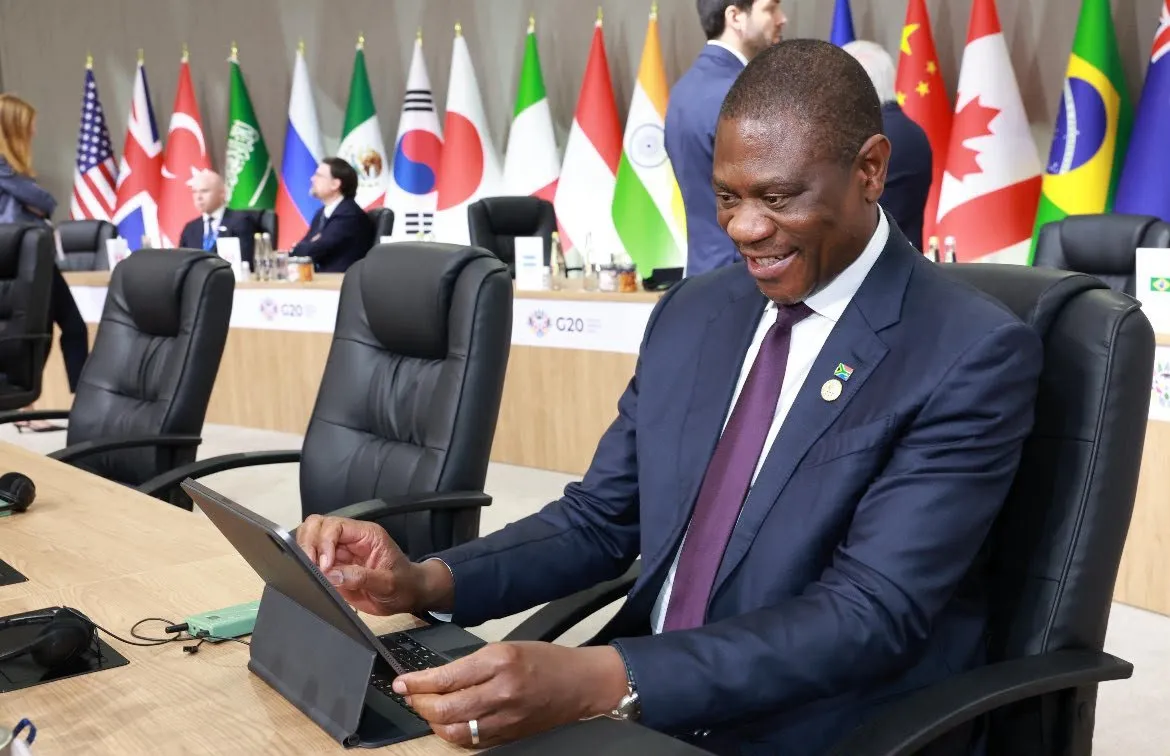

This is where some of the recent coverage of Deputy President Paul Mashatile deserves closer examination. Image: Supplied.
South Africa
#Beyond the Headlines: Why South Africa needs fair and substantive scrutiny of Paul Mashatile
There is nothing wrong with scrutinising Mashatile. As one of the country's most senior political leaders, his conduct, decisions and political record are legitimate subjects of public interest. The media has every right and indeed a responsibility to ask difficult questions.
South Africa needs a media that is fearless in holding leaders to account. But accountability is meaningful only when it is grounded in evidence, context and a genuine commitment to informing the public.
This is where some of the recent coverage of Deputy President Paul Mashatile deserves closer examination.
There is nothing wrong with scrutinising Mashatile. As one of the country's most senior political leaders, his conduct, decisions and political record are legitimate subjects of public interest. The media has every right and indeed a responsibility to ask difficult questions.
The problem arises when political journalism becomes so consumed by personalities, speculation and the minutiae of a politician's private or daily life that substantive questions about policy, governance and national priorities are pushed into the background.
Policy must come before personality
South Africans are facing serious challenges: unemployment, economic inequality, failing infrastructure, crime, energy security, public-sector performance and the quality of basic services.
These are the issues that should dominate the national conversation.
The Deputy President should be challenged on what government is doing to address these problems, whether those interventions are working and what measurable outcomes citizens can expect.
That is journalism at its most powerful.
When coverage instead focuses disproportionately on personal movements, social associations, lifestyle details or suggestive narratives, there is a danger that the public is encouraged to judge a political leader through innuendo rather than through his record and ideas.
The media should not tell South Africans what to think about Mashatile. It should provide South Africans with enough verified information to make up their own minds.
Scrutiny is not the problem selective scrutiny is
Defenders of aggressive media coverage will correctly argue that politicians cannot demand favourable treatment from journalists. That is absolutely true.
Mashatile, like every public official, must answer legitimate questions.
But journalistic independence does not mean that every negative narrative is automatically rigorous journalism. Independence also requires fairness, proportionality and context.
If allegations are made, they should be tested. If claims are disputed, the relevant responses should be reported. If government provides evidence supporting its position, that evidence should be considered alongside criticism.
A media organisation should be willing to scrutinise those in power without creating the impression that the verdict has already been reached.
The distinction is important: accountability is about establishing facts; political theatre is about establishing impressions.
Who benefits when substance disappears?
There is also a broader question worth asking.
Who benefits when political reporting becomes dominated by scandal, personalities and controversy while policy receives comparatively little attention?
It is certainly not the ordinary citizen who wants to understand whether government is improving their life.
South Africa's media landscape operates within powerful political and economic ecosystems. Major media organisations have commercial interests, audiences to retain and institutional perspectives that inevitably influence editorial choices.
That does not mean journalists are acting on behalf of business or political interests. Such claims must themselves be supported by evidence.
But it does mean that readers are entitled to question editorial patterns and ask whether coverage is contributing to a deeper understanding of the country's challenges—or simply generating another cycle of outrage and political speculation.
The answer should always be found in the evidence.
Mashatile's political history deserves context
Any assessment of Paul Mashatile must also take into account the political journey that brought him to national leadership.
Mashatile did not emerge from nowhere. His political development is rooted in the liberation movement and the political struggles that shaped democratic South Africa.
That history does not place him beyond criticism. Nor should a liberation background be used as a shield against accountability.
But historical context matters.
South Africa has a complicated political history in which individuals were subjected to repression, coercion, manipulation and political pressure during apartheid. Comparing contemporary political figures with individuals who actively collaborated with an oppressive system requires evidence and careful historical judgment.
A politician's record should therefore be assessed on its own merits rather than through loaded historical comparisons.
Mashatile should neither be protected because of his history nor condemned because of it.
He should be judged by what he does, what he says, what decisions he takes and whether those decisions serve the public interest.
The standard must be applied consistently
The real test of credible journalism is consistency.
If Mashatile is scrutinised, other senior politicians should be scrutinised with the same intensity.
If questions are raised about political influence, the same questions should apply regardless of party affiliation.
If the private conduct of one politician is considered relevant to public accountability, journalists should explain why it is relevant rather than simply assuming that the existence of a connection constitutes wrongdoing.
And where allegations are made, the burden should remain on journalism to distinguish clearly between fact, allegation, inference and opinion.
That distinction is essential in a constitutional democracy.
South Africans deserve better than political spectacle
The media is one of democracy's most important institutions precisely because it can expose wrongdoing that powerful people would prefer to keep hidden.
But that power comes with responsibility.
Journalists must challenge governments. They must investigate politicians. They must expose corruption. They must ask uncomfortable questions.
At the same time, they must resist the temptation to turn every political controversy into a morality play in which one side is automatically the villain and the other the hero.
South Africa's democracy is mature enough for a more sophisticated conversation.
The country does not need journalism that protects Paul Mashatile from scrutiny. Neither does it need journalism that appears determined to define him exclusively through controversy.
It needs journalism that investigates his record, interrogates his policies, tests allegations, examines evidence and allows citizens to reach informed conclusions.
That is not asking the media to go soft on Mashatile.
It is asking the media to be hard on the facts.
And ultimately, that is what responsible journalism and South African democracy deserves.