
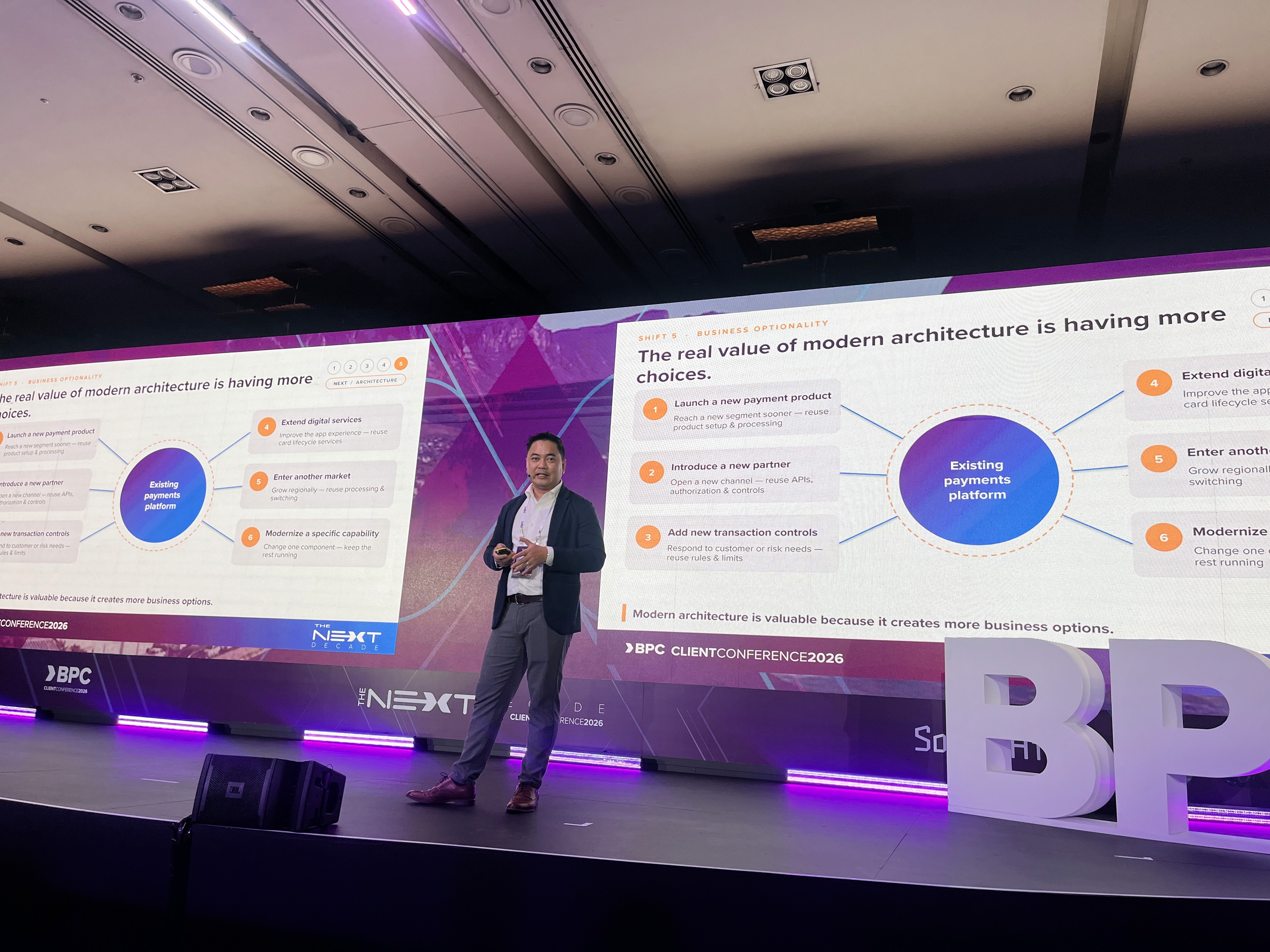

BPC APAC Regional Solution Director Jonathan Bautista says banks need to look beyond approving or declining transactions and make better use of payment data to deliver personalised services. Image: Thembelihle Mabanga
Banking
Banks can modernise payments without replacing existing platforms, says BPC executive
As digital payment methods evolve, BPC’s Jonathan Bautista says banks should focus on unlocking more value from their existing technology while preparing for a future where virtual cards, QR codes and instant payments play a bigger role.

Replacing banking technology is not always the answer to modernisation, according to BPC APAC Regional Solution Director Jonathan Bautista, who says financial institutions should first establish whether their existing platforms can meet their business needs.
Speaking at the two-day BPC Next Decade Conference in Cape Town on Wednesday, Bautista said banks often consider replacing their systems without fully assessing the capabilities they already have.
He argued that modernisation should be driven by business priorities rather than the pursuit of new technology, particularly when replacing a platform can be costly and time-consuming.
Banks should identify what they want to achieve and then determine whether their current infrastructure can support those goals, he said.
“Utilise whatever they have,” Bautista said, highlighting the importance of extracting greater business value from existing platforms before committing to major investments.
Physical cards face a changing future
Bautista also expects the way people use payment cards to change over the next decade, with virtual cards and other digital payment methods reducing the need for physical plastic.
He said cards would remain part of the payments ecosystem, but consumers would increasingly have alternatives, including tap-to-phone technology, QR codes and instant payments.
“The card itself is to be there, but the plastic will be lesser because there are alternative methods already that they can use,” he said.
Drawing on developments in the Asia-Pacific region, where he is based, Bautista pointed to the popularity of QR and instant payments as examples of how consumer payment habits are evolving.
For banks, the challenge will be ensuring their platforms can support these different payment methods as customer preferences shift.
Turning transactions into opportunities
Beyond infrastructure and payment methods, Bautista said banks could generate additional value by using transaction data to offer services that respond to customers’ behaviour.
For example, a purchase could trigger a promotional offer or an option to convert a transaction into instalments, where such services are available.
“Every transaction can trigger an event, and that event can be anything,” he said.
He said this approach would allow banks to move beyond simply processing payments and use transaction information to create more relevant customer experiences.
Bautista highlighted BPC’s SmartVista platform, which he said is used by more than 500 customers, as part of the technology landscape through which financial institutions can explore additional capabilities.
His message to banks was that modernisation should not be measured solely by how much new technology is introduced, but by how effectively their systems support business objectives and respond to changing payment behaviour.