



South Africa’s official unemployment rate has climbed to 33.6% in the second quarter of 2026. Image: AI Gaenerated
Statistics
1Min
South Africa
South Africa’s unemployment rate rises to 33.6% in second quarter
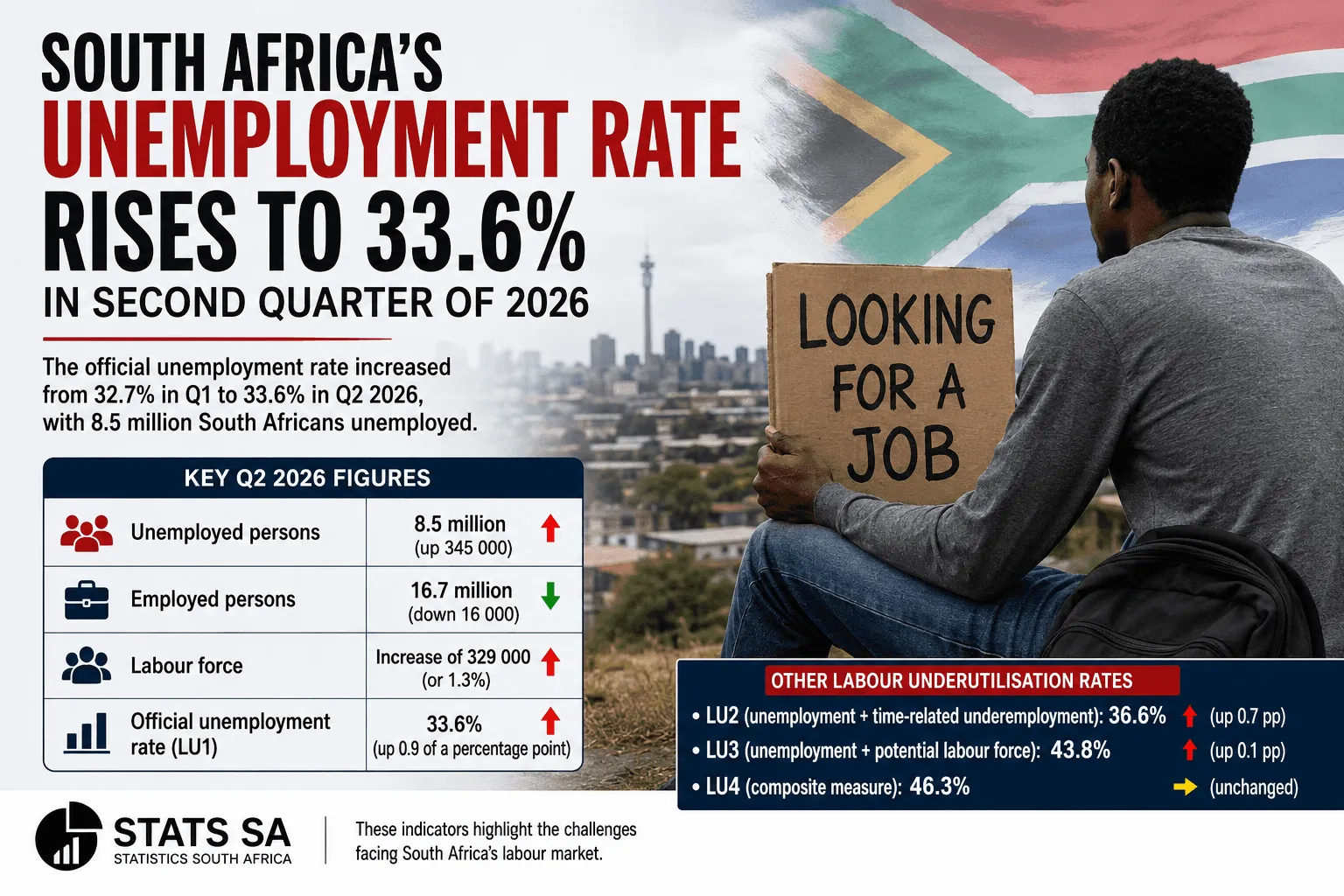
South Africa’s official unemployment rate has climbed to 33.6% in the second quarter of 2026, with the number of unemployed people increasing by 345,000 to 8.5 million.

South Africa’s unemployment crisis has deepened, with the official unemployment rate increasing from 32.7% in the first quarter of 2026 to 33.6% in the second quarter.
The latest Quarterly Labour Force Survey (QLFS) released by Statistics South Africa shows that the number of unemployed people increased by 345,000 to 8.5 million during the three months to the end of June.
At the same time, employment declined by 16,000 to 16.7 million compared with the first quarter.
The changes resulted in the labour force growing by 329,000, or 1.3%, during the period.
Stats SA said the increase in unemployment pushed the official unemployment rate, measured under the LU1 indicator, up by 0.9 of a percentage point to 33.6%.
The figures highlight the continued pressure facing South Africa’s labour market, where millions of people remain without jobs despite actively seeking employment.
The survey also recorded a decline in the number of discouraged job-seekers.
Discouraged job-seekers fell by 227,000 to 3.7 million, while other available job-seekers decreased by 49,000 to 861,000.
Unavailable job-seekers declined by 4,000 to 44,000.
As a result, the potential labour force decreased by 280,000 to 4.6 million. This category includes people who were available for work but were not seeking employment, as well as those who were seeking work but were unavailable.
The number of people outside the labour force for other reasons increased by 72,000 to 12.5 million.
Overall, the number of people outside the labour force decreased by 208,000 to 17.1 million in the second quarter.
Broader unemployment picture
The QLFS also tracks broader measures of labour underutilisation, which provide a wider picture of challenges in the labour market.
The combined rate of unemployment and time-related underemployment, known as LU2, increased by 0.7 of a percentage point to 36.6%.
The LU3 measure, which combines unemployment and the potential labour force, rose by 0.1 of a percentage point to 43.8%.
Meanwhile, the composite measure of labour underutilisation, LU4, remained unchanged at 46.3%.
The LU4 measure combines time-related underemployment, unemployment and the potential labour force as a proportion of the extended labour force.
Stats SA said these measures reflect the different degrees of attachment people have to the labour market and provide a broader understanding of labour underutilisation beyond the official unemployment rate.