


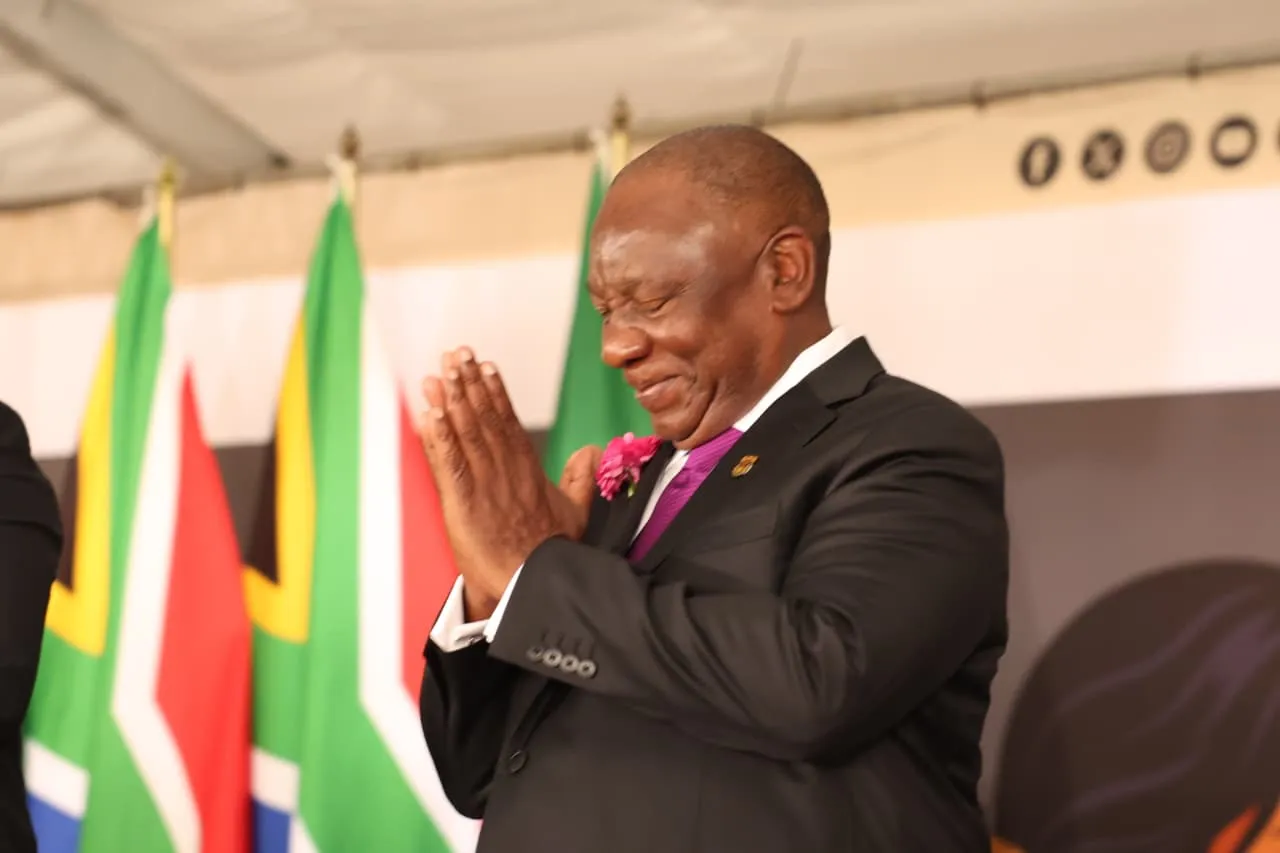

President Cyril Ramaphosa has called on South Africa to measure its progress on women’s rights not by speeches and ceremonies. Image: Supplied.
Women's Month
1Min
South Africa
Ramaphosa challenges South Africa to turn women’s freedom into measurable change
President Cyril Ramaphosa has used the 70th anniversary of the 1956 Women’s March to challenge South Africa to move beyond commemorations and deliver tangible improvements in women’s safety, economic power, healthcare and equality.
President Cyril Ramaphosa has called on South Africa to measure its progress on women’s rights not by speeches and ceremonies, but by whether women experience meaningful change in their everyday lives.
Delivering the National Women’s Day address at the Union Buildings in Tshwane on Sunday, Ramaphosa reflected on the historic march of 20,000 women to the seat of apartheid power on 9 August 1956.
He said the women’s decision to stand in silence for 30 minutes after presenting a petition containing more than 100,000 signatures demonstrated a form of resistance that was more powerful than words.
“Their silence was not empty. It was filled with dignity, discipline and determination,” Ramaphosa said.
From remembrance to results
Marking 70 years since the historic protest, Ramaphosa said the anniversary should not simply be an opportunity to celebrate the women who marched, but a moment to assess whether the country is delivering the freedom they demanded.
He said the women of 1956 were fighting against pass laws, but their demands extended to equal pay, employment opportunities, education, healthcare, land, housing, childcare and equal rights within families.
“They did not come here to ask the state to praise them. They came to demand that the state end its injustice against them,” he said.
Ramaphosa said today's generation must therefore answer the question posed by the women of 1956 through action.
“The measure of this anniversary will not be the speeches we deliver or the ceremonies we hold,” he said.
Instead, he said progress should be measured by whether a girl can grow up safe and confident, whether young women can access education and decent employment, and whether women entrepreneurs and farmers can access finance, markets and land.
Economic freedom remains unfinished business
Ramaphosa acknowledged that despite progress since the dawn of democracy, women still do not have an equal share of South Africa's wealth, land and businesses.
“Too many women are without work. Too many earn less than men for doing the same work. Too many carry the burden of caring for families and households,” he said.
He said government was working to increase opportunities for women-owned businesses through public procurement and the Women Economic Assembly, while also widening access to finance, credit and markets.
The President also stressed the importance of ensuring that women have title to the land they work.
He said education would remain central to economic empowerment, noting that women now outnumber men in universities and colleges but remain underrepresented in fields such as engineering, science, technology and artisanal trades.
‘Women cannot be free while they live in fear’
One of the strongest themes of Ramaphosa's address was the country's battle against gender-based violence and femicide.
He drew a parallel between the fear experienced by women under apartheid pass laws and the fear many women experience today because of violence.
“In 1956, women lived in fear of being arrested for not having a pass. Today, women live in fear of the gender-based violence that stalks them in the streets, even in their homes,” he said.
Ramaphosa said the classification of gender-based violence and femicide as a national disaster must result in visible and measurable change.
He called on men and boys to take responsibility for challenging violent behaviour and harmful attitudes towards women.
“Gender-based violence is not a women’s problem. It is a problem of society. It is a problem of violent men,” he said.
He rejected attempts to justify abuse through culture, religion or patriarchal norms, stressing that there is no justification for sexual harassment, abuse, rape or murder.
Healthcare placed at centre of women's freedom
Ramaphosa also placed women's healthcare at the centre of the country's equality agenda.
He said quality healthcare must be accessible regardless of a woman's income, location or disability.
This includes safe pregnancy and childbirth, reproductive healthcare, family planning, HIV prevention, cervical cancer vaccination and screening, as well as compassionate treatment for survivors of sexual and domestic violence.
He said improving healthcare for women would have wider benefits for the country's economy and society.
“A woman who is healthy, educated, safe and economically independent is better able to determine the course of her own life,” he said.
Solidarity with women beyond South Africa
The President also used the occasion to highlight the global struggle for women's rights, with Nobel Peace Laureate Malala Yousafzai among the guests at the Union Buildings.
Ramaphosa thanked Yousafzai for her activism and used her presence to express solidarity with women and girls in Afghanistan who, he said, are being excluded from education, employment and public life.
He said South Africa's own history demonstrated the dangers of allowing laws and institutions to determine what people can learn, where they can work and what role they can play in society.
“No culture, religion, government or ideology can justify reducing women to lesser human beings,” he said.
Completing the history of 1956
Ramaphosa also called for more South Africans to help identify the thousands of women who participated in the 1956 march but whose names have not been recorded in the country's mainstream historical narrative.
He welcomed the “Write Her into History” campaign by the Ahmed Kathrada Foundation and the Sophia and Henry De Bruyn Legacy Foundation.
He urged families and communities with information about women who participated in the march to come forward.
The President paid tribute to the four leaders of the historic protest — Lilian Ngoyi, Helen Joseph, Rahima Moosa and Sophie Williams-de Bruyn — and acknowledged Williams-de Bruyn's presence at Sunday's commemoration.
As South Africa marked seven decades since the march, Ramaphosa ended with a renewed commitment to building a country where women are “equal in law, equal in opportunity, equal in safety and equal in power”.
“Wathint’ abafazi, wathint’ imbokodo,” he said. “The women of South Africa have shaped our freedom and we thank them. Together, they will shape our future.”