

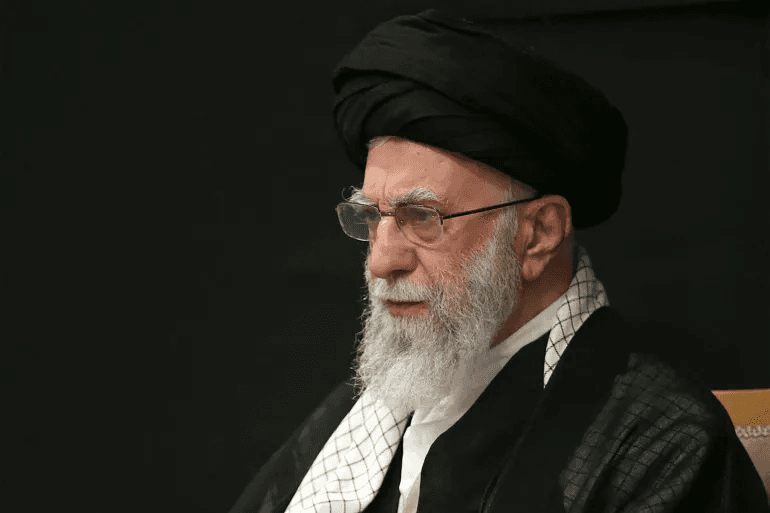

Ayatollah Ali Khamenei attending a mourning ceremony in Tehran marking the ninth day of the Islamic month of Muharram in the lead-up to Ashura, a 10-day period commemorating the seventh century killing of Prophet Mohammed's grandson Imam Hussein

Iran’s supreme leader, Ayatollah Ali Khamenei, has been killed in an attack by Israel and the United States. He was 86.
Iranian state media confirmed the death in the early hours on Sunday after US President Donald Trump said that Khamenei had been killed in a joint US-Israeli air strike that hit his compound on Saturday.
“It is announced to the Iranian people that His Eminence Grand Ayatollah Imam Sayyid Ali Khamenei, Leader of the Islamic Revolution, was martyred in the joint attack launched by America and the Zionist regime on the morning of Saturday, February 28,” Iran’s semi-official Tasnim News Agency reported. Iranian state media said that Khamenei’s daughter, son-in-law, and grandson were also killed.
Trump said earlier that Khamenei and other Iranian officials ”couldn’t escape US intelligence and the advanced tracking systems”.
Khamenei took the helm in Iran in 1989, following the death of Ayatollah Ruhollah Khomeini, the charismatic leader who had spearheaded the Islamic revolution a decade earlier.
While Khomeini was the ideological force behind the revolution that ended the rule of the Pahlavi monarchy, it was Khamenei who shaped the military and paramilitary apparatus that forms both Iran’s defence against its enemies and provides it with influence well beyond its borders.
Before becoming the supreme leader, he had led Iran as president through a bloody war with Iraq in the 1980s. The grinding conflict, coupled with a sense of isolation among many Iranians as Western countries backed Iraqi leader Saddam Hussein, deepened Khamenei’s distrust of the West, generally, and the US, in particular, analysts say.
But his rule was seriously tested over the years, including in 2009, when protesters who took to the streets over what they claimed was a rigged presidential election were met with a brutal crackdown, and in 2022 over women’s rights.
Possibly the biggest challenge to his rule came in January when protests triggered by economic hardship morphed into nationwide upheaval, with many protesters directly calling for the overthrow of the Islamic republic. The authorities’ response led to one of the most violent confrontations since the country’s 1979 revolution.
Critics saw him as being too out-of-touch with a young population seeking reforms and economic improvement over isolationism and forever shadow wars with the US and Israel.
“Iranians paid too high a cost for this degree of insistence on national independence – in the process, he lost the Iranian population because they no longer believed in the wisdom of this independence,” Nasr said.